In our Modern Age, we like to pat ourselves on the back, and pretend we’ve reinvented the wheel.
We tell ourselves that our physical training ideas are modern, we tell ourselves that they are new.
We tell ourselves that surely, no one knew how to train in the history of mankind before the advent of Instagram and TikTok.
But the reality is, we’ve been doing it since the dawn of time…and in fact, the Old Masters might be able to teach us a few new tricks!
THIS TIME, BABY, I FEEL BULLETPROOF!
One of the most important forms of training out there is what is colloquially known as Bulletproofing…it’s strengthening a particular joint by moving it through a full Range of Motion, so that it is protected from injury.
It gets blood flow to the tendons and ligaments, getting them strong and healthy so that they can support extreme feats of strength and endurance.
Likewise, their ability to get blood flow can help heal an injured joint, as tendons and ligaments don’t have their own blood supply, and need movement or manual stimulation for this.
Oftentimes, Bulletproofing is aimed at joints of the Lower Body…Ankles, Knees, the like. But it can also be for the upper body too, things like the vulnerable Shoulders, Elbows, Writs, etc.
Most Bulletproofing Exercises are primarily classified as Isolation exercises because they work at a Single-Joint. They work, as stated above, by moving the Joint through a full Range of Motion.
You can do them with added weight or by changing the leverage. You can do them in Bodybuilding Hypertrophy Reps like Ben Patrick likes to do (as did DeLorme and Watkins, whose work is the basis of much of the PT field today).[1]
You can also do them in the high rep ranges of the 100xs with only bodyweight, making the leverage easier. Thomas Kurz and Nikolia Amosov liked to do this, as did both Bob Hoffman and DeLorme and Watkins before they moved to preferring Bodybuilding Hypertrophy Ranges.[2]
Both styles are often used as a regression to prepare and protect a joint for going into a heavily weighted, Compound, Multi-Joint movement.
But however you do them, they’re not the only way to do Bulletproofing!
Enter in Accupressure!
WHAT THE AGONIST-ANTAGONIST KNEW
“Acupressure is an ancient healing art that uses the fingers to press key points on the surface of the skin to stimulate the body’s natural self-curative abilities,” Acupressurist Michael Reed Gach explains
“When these points are pressed,” he continues, “They release muscular tension and promote the circulation of blood and the body’s life force to aid healing.”[3]
This operates according to the principle of Agonist-Antagonist. What that means is is that when one muscle is stretching, its opposite muscle is tightening, contracting, and strengthening.
By applying pressure at the Acupressure Point with our fingers, we are stretching, loosening, and relaxing the muscle we are applying pressure to…and at the same time tightening, strengthening, and contracting its opposite.
THE SECRET TO ITS SUCCESS
This is a wonderful technique, because it works on the same principle as Static Passive Stretching, which Thomas Kurz defines as “relaxing your body into a stretch and holding there by the weight of your body or by some other external force.”[4]
Essentially, your fingers are the external force that is allowing you to stretch the muscle-agonists. If you are tired or injured and can’t streetch them yourself, your fingers just do it for you…that’s the essence of Accupressure.
You can do this for time in Static holds…I recommend anywhere from 3-5 minutes.
Or you can do them Dynamically and fast, planting your fingers at the desired Acupressure Point, and rubbing it in a circle at the planted point.
Even better, you can push down with your fingers in a light “pulsing” motion…kinda like using your fingers as a jackhammer to break up the “concrete” of muscle tightness.
I prefer to do the Pulsing myself, as I like Dynamic a lot better than Static, and I find it has a soothing effect due to its repetitive nature. I like to do sets of 100x reps here.
But there is another part of the Agonist-Antagonist muscle relationship you may not be aware of…and one simple, important tool to work it…
WHAT THE SARAN WRAP REVEALED
Surrounding all of our muscles in the body is a substance called Fascia. It’s a connective tissue that has nerves in it, and it’s a substance that is like saran wrap all around our muscles.
Fascia can become tight and constricted, just like the muscles they surround. And this can become a problem.
Say a muscle is tight, and you are trying to stretch it. Maybe you’re doing it for a Static hold. Maybe you are Dynamically working to move it through it’s fully available Range of Motion.
Remembering the Agonist-Antagonist Principle, you work on stretching, loosening, and relaxing the muscle, while its opposite muscle tightens, contracts, and strengthens.
Again, maybe you’re doing it for a Static hold. Maybe you are Dynamically working to move it through its fully available Range of Motion. And maybe now, you are using the external force of your hands in Accupressure…whether Statically or Dynamically.
You may think you have exhausted your options…
But you haven’t!
There’s another simple, mechanical tool you can use…and it’s so easy, even a caveman can use it…
HAIR BRUSH FOR THE FASCIA
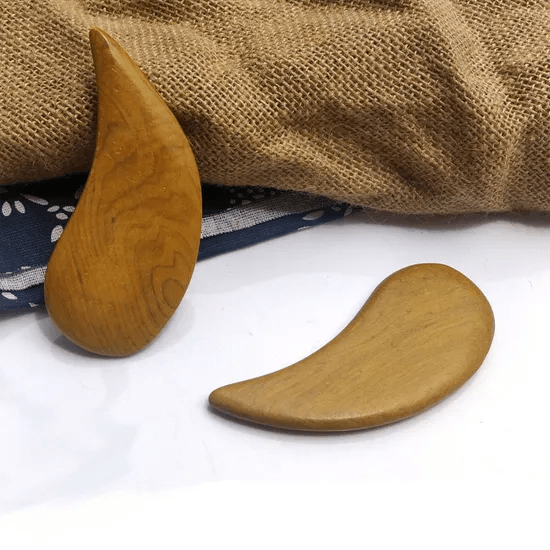
Some call it a Gua Sha. Others call it a Graston Tool.
I like calling it the Wooden Tool myself…it’s a little less pretentious that way!
Whatever you call it, it’s a small series of cheap tools that come in different shapes. Some are made of wood, others metal, and others from precious stones like jade or amethyst.
If you can’t get a hold of these, you use a wooden cooking spoon, the non-serrated side of a metal butter knife blade, or even a simple metal spoon.
What’s the job of these tools?
Stretch the Fascia.
But instead of a circular or pulsing motion like you use with your fingers, you use a scraping motion
It’s pretty easy…make sure you have some kind of cloth covering like clothing or a cloth over the area you need to scrape. You can also use lotion if doing it on bare skin.
If you’re doing it on your bare skin, don’t do it without lotion…you will literally peel your skin off!
From there, all you do is scrape!
It’s like brushing your hair, but it’s brushing your skin.
Apply as much pressure as you feel you need to in hair brush-like strokes, as long or as short of strokes as you feel you need, as fast or as slow as you feel you need, and feel the fascia release!
It’s that simple!
THE SKY IS THE LIMIT!
Having a knowledge of anatomy is key to using the Wooden Tool for Fascia Scraping.
Understanding where the Fascia Train Lines are in the body allows you to strategically target them.[5] For sets and reps, I like to hit sets of 100x reps dynamically, of course.
Are you sensing a theme here?
Once you get the Fascia opened up, with with Acupressure or the Wooden Tool, the breaks are off, and the sky is the limit!
Integrate these Single-Joint, Isolation Bullet-Proofing Exercises with Compound, Multi-Joint Coiling Core type movements, and the movement world is yours!
Pulp Fiction Power to you, my friends!
Sincerely,
Richard Barrett
09-29-2024
Written at 1:36 PM, somewhere in the USA…
Updated on 03-29-2026 at 9:13 PM, see Note [6] under the section Sources Cited.
Sources Cited
[1] For Delorme and Watkins’ rep ranges, see John, Dan. The Hardstyle Kettlebell Challenge: A Fundamental Guide to Training for Strength and Power. Dragon Door Publications: Little Canada, MN: 2017. Pgs. 79-81. You can also find the original study sold here.
[2] For Thomas Kurz, see Kurz, M.Sc., Thomas. Science of Sports Training: How to Plan and Control Training for Peak Performance. Stadion Publishing: Island Pond, VT, 2001. Pgs. 163-165. For Dr. Nikolai Amosov, see Tsatsouline, Pavel. Super Joints: Russian Longevity Secrets for Pain-Free Movement, Maximum Mobility, and Flexible Strength. Dragon Door Publications: St Paul, MN, 2001. Pgs. 3-14.
[3] Gach, Michael Reed. Acupressure’s Potent Points: A Guide to Self-Care for Common Ailments. Bantam Books: New York, New York, 1990. Pg. 3.
[4] Kurz, M.Sc., Thomas. Stretching Scientifically: A Guide to Flexibility Training. 3d Edition. Stadion Publishing: Island Pond, VT, 1994. Pg. 29. Please note that the 4th Edition is found in the link above.
[5] For Fascia Train Lines, see Training Academy, Fascia. “The 7 Most Important Fascia Chains”. Fascia Training Academy, September 20, 2022. https://fasciatrainingacademy.com/the-7-most-important-fascia-chains/. Note that this article is cited as an excerpt from Muller, Divo G.; Schleip, Robert. “Fascial Fitness: Fascia oriented training for bodywork and movement therapies”. Terra Rosa e-magazine, Issue no. 7, 2001. Pgs. 2-11. https://www.semanticscholar.org/paper/Fascial-Fitness-Fascia-oriented-training-for-and-M%C3%BCller-Schleip/786b69a90f65a1bb84ee952b7a624eb580de5988.
[6] Note: this piece was updated on 03-29-2026 at 9:13 PM to reflect greater understanding of Acupressure and Gua Sha scraping’s relation to Agonist-Antagonist Muscles that I developed on 01-21-2026.
Originally, I was under the impression that the Acupressure was tightening, strengthening, and contracting the target area and stretching, loosening, and its opposite.
I had this backwards, and discovered this on 01-21-2026.
I was also under the impression that training Fascia and Muscle operated along different principles. In this again, I was mistaken, as I discovered on 01-21-2026.
Furthermore, the updates also reflect my learning the Pulsing Method of Acupressure from Dr. Jessica Stavale on 08-05-2025 via this Instagram Post: Dr. Jessica Stavale (@thefasciamovement). “⚡️THE PULSE: Deep Fascia. Deep Change.⚡️”, Instagram Post, July 5, 2025. https://www.instagram.com/p/DLtl1daNlVh/.
I noted to her in a comment on this instagram post on 08-09-2025:
“@thefasciamovement your Stavale Method has been a game changer before me. For the last year and a half, I have been a bodyworker…
“I’ve done a lot of stuff with guasha-based fascia release on my clients, first always testing on myself. I’ve always done circles with my fingers, and strokes with various guashas…but like an idiot, I never thought of pulses.
“I’ve experimented with this a lot on myself. And while I like 3-3-3-, I have found I get better results with 100 short pumps…I call it “The Precision Jackhammer”, because it drills down steadily to break the fascia up like a jackhammer on a job site.
“I’ve found it very interesting how sets and reps work with fascia…people think they only go with exercises involving joint movements…but they go with fascia therapy too!
“I found that in testing your 3-3-3 method, it felt like the ‘powerlifting’ of fascia. Low reps, but targeted for a certain intensity. When cranking the reps up to 100 short pumps, I felt like it was like ‘high rep calisthenics’, like push-ups or squats with a long, soft, rhythmic feel.
“Thank you for exposing me to this…I would not have figured it out without you! I will be recommending your stuff to all my fellow trainers!”
 PULP FICTION RENAISSANCE