This could be one of the most important pieces I have ever written.
The below piece, From the Vault, is a direct response to Lt. Col. Dave Grossman’s much-vaunted book, On Killing: The Psychological Cost of Learning to Kill in War and Society.
It’s provocatively titled, and it’s bound to turn some heads.
I wrote this piece in October of 2016 for a class at Regent University, in pursuance of my Bachelor of Arts Degree in Political Communications.
I updated it on June 25, 2021, and gave it to a family friend who was about to ship out for the Marine Corps.
I am publishing it publicly here for the first time.
Quite frankly, I believe that the thesis laid out in Lt. Col. Dave Grossman’s On Killing has caused much avoidable PTSD for our Fighting Men and Women during the Global War on Terror.
What’s worse, I believe that this problem has been even more severe for Christians within the ranks.
As such, I wrote this piece below to solve the problem.
It’s for our Warfighters and Law Enforcement Officers who Society has entrusted the grave task of dealing death as the appointed Posse Comitatus of our Nation.
This piece is built upon the foundation of Philosophy, History, Theology, and Anthropology.
And it gives a voice to the Fighting Men themselves.
So without further adieu, I give you…
LIVE AND LET DIE:
KILL LIKE A CHRISTIAN
By Richard Barrett
This Paper is War Memorial to the Heroes of Our Generation
To the Warfighters: The Strongmen
Lt. Col Daniel Laux, Capt. Vincent Bonecich, Lt. Col. Kevin Glathar (Ret.), MSgt. Albert Schapney (Ret.), MSgt. Carlos Rojas, Lt. Col. Douglas V. Mastriano, Guy Roberts, Shawn Rosalez, James Corbyn, Cody Nix, and Josh Paul.
To the People: The Gifts of God
Malik, Miriam, Ki-Ro-Los, Wael, Khismet, Sabhia, Fahdi, Teodora, Ema, and Penka.
To the Debaters: The Spirit of Striker Blue Force
Jason Gordon, and all Great Debaters everywhere who embrace the “Overkill Doctrine”, past, present, and future. “Man, if this was real l’d join up right now!” It’s real, buddy.
To the Omega Men: Who Triumphed Where Gilgamesh and Enkidu Failed
James Lafond and Lloyd du Jongh: Frontier Scouts, Mystic Shamans, Civilian Warriors. Coaches. Mentors. Friends.
To My Family
Mom, Dad, Harrison, Hayden, Liberty, Donovan: who showed me the way.
And to God Almighty
I thank you for these Great Friends who have shown me the Honor in myself, and for the Great Enemies I’ve gotten to test it against. I pray for more of both in equal measure.
“I loved you, so I drew these tides of
“Men into my hands
“And wrote my will across the
“Sky and stars
“To earn you freedom, the seven
“Pillared worthy house,
“That your eyes might be
“Shining for me when I came”[1]
T.E. Lawrence of Arabia, The Seven Pillars of Wisdom
“Inspire everyone, Oh God
“with love alive for freedom, then
“each one will struggle as he could,
“with all the enemies of men.”[2]
Hristo Botev, “My Prayer”
“We Americans might have lost a war, but that family had lost a country…I wanted so badly to let them know that I was David Donovan, that I had fought the Terror, that no one may know me but I was once a warrior king!”[3]
Capt. David Donovan, Once a Warrior King
Please Note: This piece is not a call to violence against any religious, racial, ethnic, or political group or any individual members of any religious, racial, ethnic, or political group. It is a philosophical and historical examination of the morality and ethics of killing in war time when legally sanctioned by legitimate authorities.
LIVE AND LET DIE:
KILL LIKE A CHRISTIAN
On December 23, 2014, while most American parents were enjoying the Christmas season with their children, one Libyan family was living a nightmare.
Katherine was a 13-year old Coptic Christian girl who watched in horror as her parents were murdered by Islamic State terrorists before her very eyes. She was then kidnapped by her captors and shot twice in the head and once in the back, her dead body dumped in the desert.[4]
On February 18, 2016, Father Yacob Boulos was dragged from the Altar of his Church in Syria and beheaded by Islamic State terrorists. His crime? Praying at the Altar.[5]
On May 12-13, 2016, Islamic State terrorists entered into the town of al-Zara, Syria, and began a holocaust of horror, beheading the men and abducting the women and children. The women were raped and then executed.
The children were murdered too.[6]
Across the globe, evil is ascending and is on the march. At home and abroad, these forces seek the destruction of our way of life and the Judeo-Christian values we hold dear. We are at war with the forces of darkness in a battle to death.
There can only be one winner.
What has been the Christian response to this rise of evil across the Globe?
Nothing.
Christians in America and Western Civilization have stuck their heads in the sand as their Brothers in Sisters in Christ are slaughtered for their faith.
Christians in America and Western Civilization have stuck their heads in the sand as their Brothers and Sisters in Humanity, made in the Image of God, are exterminated en mass.
Christians in America and Western Civilization have stuck their heads in the sand as the menace of evil marches upon its very shores and brings its reign of murder and mayhem home.
Today, Christians in America and Western Civilization are possessed by the Satanic Spirit of Munich, 1936. It was that spirit that allowed for the Holocausts of Hitler and the Mass Genocide perpetuated by Japan.
General Curtis E. Lemay, USAF, led the firebombing campaigns against Germany and Japan to halt their Holocausts. He flew point himself on bombing runs, in time manning every position on the bombers. He pioneered the firebombing of Japan.[7]
Reflecting on how he ended the Axis horror, he said this:
“You’ve got to kill people, and when you kill enough of them, they stop fighting.”[8]
Today, to halt the Holocaust by the Barbarians at the Gates and preserve our Judeo-Christian Way of Life, we must embrace the Truth understood so well by General Lemay.
Christians have to learn to live and let die.
Christians have to learn to kill like Christians.
Lucky for us, the Bible teaches us how, and the experience of mankind at war for over 10,000 years shows us the way.
CHRISTIAN WARFIGHTING TODAY
Christians today view warfighting as a taboo. As such, warfighting is considered “beyond the pale” for discussion in Christian circles. A deep understanding of conflict and killing is ignored as sinful, even as a violent world acts as an elephant in the room, demanding an answer from followers of Christ.
The failure for Christianity today to provide an answer to the quandary of warfighting is symptomatic of a greater failure within the Church of our time. Specifically, the Church no longer looks at truth as a total system to encompass all of man’s experiences.
This has not always been the case. In fact, for much of Christianity’s history, the truth as revealed by God and rationally understood by man as immutable Laws of Nature have been viewed as covering all aspects of life, including–and especially–warfighting.
Warfighting forms the basis of temporal life or death on this earth, and is a core aspect of the human experience. Ignoring such a core experience with such life or death significance is a major failure on the part of any system of thought. Today, that system of thought is Christianity.
Christianity ignored this core experience specifically because it no longer sees itself as a holistic and all-encompassing system. This mentality began to poison Western Civilization with the Idealist works of Immanuel Kant, Jean Jacques Rousseau, and Georg Hegel. Essentially, their epistemology of life made thinking of Christianity as a total and all-encompassing impossible.
How did they do this?
By dividing the world into two spheres: Freedom and Nature. In the Idealist view, these two spheres were irreconcilable and could not be combined. Nature consisted of all of life, while Freedom meant a rejection of all aspects of life to achieve a mystical state of total liberation. This would create Rousseau’s famed “Noble Savage,” and was in fact, man’s natural state before he was corrupted by current physical culture of Nature.[9]
This clearly contradictory doctrine (man’s natural state is to reject Nature?) has many implications for existence, not the least of which is warfighting. Friedrich Schiller synthesized the Idealist view on warfighting in his 1801 On the Sublime. “Either actually, when man opposes violence with violence, when he has nature rules over nature; or ideally, when he steps out of nature and so, in regard to himself, annihilates the concept of violence,” says Schiller.[10] He goes on to explain that:
“Can he therefore no longer oppose to the physical forces a proportional physical force, so nothing else remains left to him and to annihilate as a concept the violence, which he must in fact suffer. To annihilate violence as a concept, however, is called nothing other than to voluntarily subject oneself to the same. The culture, which makes him apt thereto, is called moral.”[11]
In the view of the Idealists, by subjecting himself to violence without fighting back, man has actually made violence impossible by ascending to a higher plane of existence, Freedom. Even though he is dead.
Ivan Ilyin discussed how this worked out in real-life. A Russian Christian, Lawyer, and Philosopher, he fled as a refugee in exile from the Soviet Union in the wake of the Russian Civil War. Reflecting on the conditions that led to the horror of mass murder at the hands of the Communists, he said:
“One of the reasons for the great misfortune that has befallen our country is in the wrong structure of the Russian character and Russian ideology. Especially so in the broad ranks of the Russian intelligentsia… the pernicious doctrine of Count Leo Tolstoy “of non-resistance to evil by force” emerged and gained strength; the doctrine which had time to poison the hearts of more or less several generations in Russia, and undetected spilled into their souls and weakened them in the fight against the evildoers.”[12]
At the end of the day, Katerine, Father Yacob Boulus, and the citizens of al-Zara are all dead. They did not reach a higher plane of existence, Freedom, by being slaughtered against their will.
The peoples of Europe, Asia, and Russia who were slaughtered at the hands of the Nazis, Japanese, and Communists did not reach a higher plane of existence either.
They were just murdered.
And it was men like General Curtis E. Lemay who halted the Nazi and Japanese horror and held the Communist menace at bay as commander of America’s nuclear-armed Strategic Air Command.
Denying that fact that Nature is a part of life is to deny reality. To deny reality is to deny God. God is reflected in Nature and it works according to his Laws. The Bible says in Romans 1:20, GNT, that “Ever since God created the world, his invisible qualities, both his eternal power and his divine nature, have been clearly seen; they are perceived in the things that God has made. So those people have no excuse at all!” It goes on in Romans 2:14-15, GNT, to explain that:
“The Gentiles do not have the Law; but whenever they do by instinct what the Law commands, they are their own law, even though they do not have the Law. Their conduct shows that what the Law commands is written in their hearts. Their consciences also show that this is true, since their thoughts sometimes accuse them and sometimes defend them.”
God’s Law governing Nature values humanity as made in the Image of God while recognizing it is limited in scope and responsibility, that humanity is not God itself. This is the view of a total and all-encompassing system that does not reject Nature and reality, but instead embraces it.
Historically, this understanding has been called in the Church, the Great Chain of Being. [13] It recognizes that God is above Man, and in His goodness He made Man in his Image to dominate the earth, while still making him a finite being with a limited amount of control and subsequent responsibility. Being below God, all things are not Man’s duty, but the duties and areas of control Man is given are ones we must embrace, for God has seen fit to give them to us, and to shirk in those duties would be to act as if it were not fit to God to give them to us.
CURRENT VIEW ON WARFIGHTING TODAY
“The special sciences are trees,” said Ayn Rand, “But philosophy is the soil which makes the forest possible.”[14]
We have seen the philosophy from which ideas concerning warfighting have emerged. Out of this philosophy that rejects Nature and subsequent reality has arisen false theories of human behavior to fit into the anti-Nature mold. Nowhere is this truer than in the social sciences’ study of warfighting.
Perhaps the most well-known proponent of this school today is Lt. Col. Dave Grossman and his self-proclaimed “Killology” branch of social science. Grossman states that 98% of the world’s population is biologically incapable of violence. Therefore, warfighting is only the domain of 2% of humanity. This creates a three-tiered class system that is famously known as “Sheep, Wolves, and Sheepdogs.”
First, the 98% are sheep. Since they are incapable of violence, they can put no one in danger. Subsequently, this puts them at the mercy of 1% of the world’s population, the Wolves, who are biologically capable of unrestrained violence. Standing in between them are the Sheepdogs, a sheep-wolf hybrid that forms the remaining 1% of the world’s population that is biologically capable of both violence towards the Wolves and empathy toward the Sheep.[15]
Historical evidence from the past and present put a reality check on Grossman’s theory. Since the dawn of time, man’s basic form of political organization has not been the state in which 98% of the population could be shielded from violence, but instead the tribe.[16] In the tribal system, all men were warriors and were called upon to fight continuously in which upwards of five hundred times more casualties than contemporary combat suffered by society as a whole.[17] [18]
This natural, hard-wired propensity for violence is something alive and well in the modern times, as Vietnam veteran Alfred S. Bradford discovered:
“One of our medics, a conscientious objector, had been brought up in a religion which taught that violence is learned behavior. He was excused from all weapons training on grounds of religion. He had never handled a firearm in his life. In Vietnam one night while his company was set up in a peaceful hamlet in a pacified area the NVA [North Vietnamese Army] struck. He was in a hootch [local house] working on a wounded man when an NVA soldier with an RPG on his shoulder appeared in the door. The medic grabbed the wounded man’s M-16 and shot the NVA soldier dead. In a split-second without a conscious thought he killed another human being.”[19]
Mankind then, is not divided into Sheep, Wolves, and Sheepdogs. Instead, in the words of the Romans, “Homo Homini Lupus.”
“Man is Wolf to Man.”[20]
THE BIBLICAL VIEW
Because we live in reality and our embrace of Nature, we can return Christianity to its rightful place as the ultimate total and all-encompassing system that God intended it to be for us. In the core experience of warfighting, this means answering three questions:
1.) Why We Fight
2.) Responsibility and Morality of the Fight
3.) Dynamics of the Fight
WHY WE FIGHT
First, as Christians we fight and subsequently kill (remember Lemay: “You’ve got to kill people, and when you kill enough of them, they stop fighting.”[21]) to protect the defenseless. “You shall not murder” commands the Lord in Exodus 20:13, and the defenseless have a special place in this command.
“You shall not afflict any widow or fatherless child. If you afflict them in any way, and they cry at all to Me, I will surely hear their cry; and My wrath will become hot, and I will kill you with the sword; your wives shall be widows, and your children fatherless,” commands the Lord in Exodus 22: 22-24.
Second, as Christians we fight and subsequently kill to enforce Justice. God commands in Genesis 9: 6 that “Whoever sheds man’s blood, By man his blood shall be shed; For in the image of God He made man.”
Furthermore, God speaks specifically of the actors who carry out this command. Romans 13:1, 4 declares that “Let every soul be subject to the governing authorities…For he is God’s minister to you for good. But if you are evil, be afraid; for he does not bear the sword in vain; for he is God’s minister, an avenger to execute wrath on him who practices evil.”
Third, as Christians we fight and subsequently kill in Self-Defense. This is reason physically allows for the first two. If we are not alive, we cannot enforce Justice subsequently protect the defenseless.
The Bible gives us an example of this kind of self-defense as groups and individuals, a type of war for survival that Hebrew Tradition refers to as Milhemet Mitzvah.[22] Esther 8:11 tells us that “By these letters the king permitted the Jews who were in every city to gather together and protect their lives to destroy, kill, and annihilate all the forces of any people or province that would assault them.” The Esther 9:1-2, 5 goes on to describe the subsequent engagement:
“On the day that the enemies of the Jews had hoped to overpower them, the opposite occurred, in that the Jews themselves overpowered those who hated them. The Jews gathered together in their cities throughout all the provinces of King Ahasuerus to lay hands on those who sought their harm. And no one could withstand them, because fear of them fell upon all the people… Thus the Jews defeated all their enemies with the stroke of the sword, with slaughter and destruction, and did what they pleased with those who hated them.”
Furthermore, while the term “Governing Authorities” in Romans 3: 1, 4 brings to mind images of police and military personnel, we must remember that we are thinking in terms of the post-Westphalian Treaty system that established the state as a governing apparatus as we know it. For much of history, this was not the political system of organization, the “the governing authorities”, the tribe was. As we have seen, every male had a militant responsibility in the tribal system, so even those fighting age males who we would think of as civilians traditionally form “the governing authorities.”
Subsequently, no matter what the governmental system, whether tribe or state, “the governing authorities” are not a lifeless form, but human beings just like you and me.
So bringing it all together, as Christians we fight and subsequently kill as a rite of passage into manhood and a test of faithfulness unto God’s commands. The Hebrew Tradition refers to this type of warfare as Milhemet Reshut.[23] Judges 3: 1-4, GNT, explains this:
“So then, the LORD left some nations in the land to test the Israelites who had not been through the wars in Canaan. He did this only in order to teach each generation of Israelites about war, especially those who had never been in battle before. Those left in the land were the five Philistine cities, all the Canaanites, the Sidonians, and the Hivites who lived in the Lebanon Mountains from Mount Baal Hermon as far as Hamath Pass. They were to be a test for Israel, to find out whether or not the Israelites would obey the commands that the LORD had given their ancestors through Moses.”
Thousands of years later, during the Crusades, the Book of Judges was translated into English for the spiritual use of the Knights Templars, defending the Christians of the Middle East against barbaric genocide at the hands of the Islamist Saracens. The Knights were the Special Operations Forces of their day, and were greatly feared by their Islamist Saracen foe–an enemy motivated by the same ideology of groups like Al Qaeda and ISIS in our time.[24]
During this time, very little of the Bible was translated into the common tongue of Christians throughout Europe, due to the scarcity of the printing press. However, the Church, at this time still dedicated to teaching the truth about God’s Laws governing Nature, understood their elite fighting forces needed the spiritual perspective of the fight they were in—a thousand years later, in the same land, against the same enemy.
And because of that, it was the same passages found in Judges 3:1-4 that motivated them to fight unto the death against the savage foe, as recounted by Jacques de Vitry, Bishop of Acre to the Knights Templar from 1216-1228:
“You should always be prepared to shed your blood for Christ, that is to say, to lay down your lives for God with desire and the sword, following the example of a certain knight of Christ who when he saw the great number of Saracens, began to speak out of his great faith and the joy of his heart, and to say to his horse: ‘Oh Blackie, good comrade, I have done many good day’s work by mounting and riding on you; but this day’s work will surpass all the others, for today you will carry me to eternal life. After this, he killed many Saracens, and at last fell himself, crowned in battle with fortunate martyrdom.”[25]
In Hebrews 11:1-2, 32-34, 39, GNT, the Bible lionizes the legends of the Book of Judges who answered the call God issued in Judges 3:1-4 as Heroes of the Faith, and holds them up for a model of behavior for the future generations unto today:
“To have faith is to be sure of the things we hope for, to be certain of the things we cannot see. It was by their faith that people of ancient times won God’s approval…Should I go on? There isn’t enough time for me to speak of Gideon, Barak, Samson, Jephthah, David, Samuel, and the prophets. Through faith they fought whole countries and won. They did what was right and received what God had promised. They shut the mouths of lions, put out fierce fires, escaped being killed by the sword. They were weak, but became strong; they were mighty in battle and defeated the armies of foreigners… What a record all of these have won by their faith!”
RESPONSIBILITY AND MORALITY OF THE FIGHT
Every one of those Jews that won the victory for their people in Esther 8:11, 9-12, 5 were individual human beings. And every one of those Israelites and Crusaders who answered the call in Judges 3:1-4 and slaughtered their foes were individual human beings. And those Israelites and Crusaders celebrated for it in Hebrews 11:1-2, 33-34, 39, GNT, well they were individual human beings, too.
As we have seen, self-defense is the starting point for all warfighting, because if you yourself are not alive, you cannot engage in combat, whether for good or evil purposes.
Because of this fact, it is the individual self that is the nexus of all understanding the Responsibility and Morality of the Fight.
The Bible is very clear about personal responsibility. Because man is made in the Image of God, he has innate dignity. However, because he is not God, is below God, and is indeed finite. God says in Isaiah 55:8-9 that “‘For My thoughts are not your thoughts, Nor are your ways My ways,’ says the Lord. ‘For as the heavens are higher than the earth, So are My ways higher than your ways, And my thoughts than your thoughts.”
Because of this, man is not given charge over all things in his life. He is given charge of possession of a limited amount of things. With this charge of possession comes responsibility for them. The first and most important, and out of which all flows, is himself. 1 Timothy 5:8 displays the gravity of his command: “But if anyone does not provide for his own, and especially for those of his household, he has denied the faith and is worse than an unbeliever.”
Until the time of Kant, Rousseau, and Hegel, philosophers since the dawn of time have embraced this principle. Classical Reasoning in the West up until the era of these Idealists started from the premise of Rationalism: that man started only with himself and worked outward, proving Romans 1:20, GNT, that “Ever since God created the world, his invisible qualities, both his eternal power and his divine nature, have been clearly seen; they are perceived in the things that God has made. So those people have no excuse at all!” As we have seen, this is further fleshed out in Romans 2:14-15, GNT:
“The Gentiles do not have the Law; but whenever they do by instinct what the Law commands, they are their own law, even though they do not have the Law. Their conduct shows that what the Law commands is written in their hearts. Their consciences also show that this is true, since their thoughts sometimes accuse them and sometimes defend them.”
It is to this Eternal Law of Nature that we must look to understand Warfare… and we will find this Law operating in some very unlikely places.
CONFLICT OF LIFE
The truth is, all of life is built upon Conflict. The Stoics and the Greeks and the Romans called this concept Agon. The Hebrews of the Bible called this concept Kavash. It is the foundation upon which all of life is built. Lt. Cmdr. James Bond Stockdale, Medal of Honor Winner and Hero of the Hanoi Hilton, defined this as “Competition, stress, pressure, struggle to win”.[26]
The world is composed entirely of opposite forces in competition, creating stress for the opposing force. In this way, a bow is able to be drawn back and fired because the opposite ends of the string are pulled to produce stress upon one another. The same goes for string-based instruments to create the masterpieces of the music. Even all architecture, from the humblest hovel to the grandest temple, is composed of tension and compression—how the materials successfully handle the stress of loads from other materials.[27] This fact is the very idea underpinning Sir Isaac Newton’s Laws of Motion, which keep life together![28] All of this, this is called Dialectic, “the struggle of opposites,” and in this competition, there is a winner and a loser.[29]
Find out for yourself: get up out of your chair and take a few steps. You were able to move because your feet fought the friction of the ground, and in the end you overcame that friction and moved. You won.
Without that friction, you couldn’t have moved at all. You needed that force to oppose you in conflict in order for you to achieve your goal. If that friction wasn’t there, you’d slip and fall on the floor.
That’s the nature of life, and it’s what Stoic Soldier and Roman Emperor Marcus Aurelius meant when he said, “the impediment to action advances action. The obstacle becomes the way”.[30]
But life isn’t just Conflict. It is Conflict in pursuit of a Goal.
Mankind is a Goal-seeking creature. Aristotle and Thomas Aquinas call this by its Latin name, “Telos”.[31] In the example above, your goal was to get from point A to point B by taking a few steps. Friction opposed you in achieving your Goal.
There you go, there’s your Conflict. You fight; you take your steps and you made it. You’ve achieved your Goal. You’ve won.
Because this is the nature of all life’s creation, then all of life’s creations are Warriors. “Vivere militare!” said the Stoics. “‘Life is being a soldier.’”[32]
In life, there are many different types of conflicts. Janet Burroway Literary English scholar lays these types of conflict out in Writing Fiction: A Guide to Narrative Craft. These are:
- Man against Man
- Man against Nature
- Man against Society
- Man against Machine
- Man against Himself[33]
Now, specifically, in the case of warfighting, our flesh and blood enemy of man is the obstacle, and our goal is to kill him or die trying. This is something commanded and celebrated in Judges 3:1-4 and Hebrews 11:1-2, 32-34, 39.
And within this context, the warriors of the Judeo-Christian, Western, Indo-European Tradition fight very differently than other war fighting cultures around the world.
It’s called Confrontational Warrior Culture.
CONFRONTATIONAL VS. PREDATORY
Confrontational Warrior Culture is something unique both to the Hebrew and Indo-European warrior peoples of the West. To understand it, first we’ve got to understand the Warrior part of the culture.
Confrontational Warrior Culture comes from 4 groups of Warriors:
- The Ancient Hebrews
- The Ancient Greek Hoplites
- The Ancient Roman Legionnaires
- The Ancient Germanic Barbarians[34]
And even though these different tribes of heroes both fought and befriended each other at different stages of history, they all had one thing in common: they love to fight! They love nothing more than to test their strength against a worthy opponent, and find great joy and fulfillment in the battle. But they do it in a special way that is “Confrontational”.
And so we come to the second part of the culture we’ve got to understand, Confrontation itself. An example will explain best.
Think back to the old Black-and-White Westerns like Gunsmoke you watched with your grandparents.[35] Marshall Matt Dillon goes out into the street to face the bad guy in a fast draw show-down and blasts the bad guy away. Up front, mano-a-mano, straight-shooting. It’s clean, noble, and honorable.[36] That is Confrontation.
In fact, the word “Noble”, translated into English from the Greek word “Kalon”, translates literally into a “Warrior who fights Confrontationally”![37]
In the end, it creates a Warrior that is, as Wilhelm Gronbech described, “generous, brave, fearless, quick-witted, stern towards his enemies, faithful to his friends, and frank with all.”[38]
And it is very different from the other Warrior Cultures around the world with which you are probably familiar. Because to truly understand what Confrontation is, you’ve also got to understand what it’s not.
Confrontational Warrior Culture is the exact opposite of Predatory Warrior Culture.
Predatory Warrior Culture is stab-in-the-back, shooting fish in a barrel style of fighting, and all the torture and mutilation that goes with it.
Predatory Warrior Culture does these things because the powerlessness of the fish juxtaposed alongside the all-consuming power of the human with a gun makes them feel powerful.
But the Confrontational Warrior takes a different track.
The Confrontational Warrior believes that he who is strongest can beat the best! That’s why the Confrontational Warrior doesn’t shoot fish in a barrel! They’re just fish who can’t shoot back!
So the Confrontational Warrior does the exact opposite of stab-in-the-back, shooting fish in a barrel style of fighting.
He doesn’t seek out the weakest, most pathetic, helpless victim he can find that he’s got a sure chance of beating.
No, he seeks out the roughest, toughest Predator on the entire frontier to beat to punish him for his misdeeds!
This doesn’t mean he fights stupid or gives away advantages. The best way to think of it is in a Brazilian Jiu-Jitsu or MMA match. The fighters slide palms and bump fists and the game is on. That is Confrontational. Sure, they will use every stratagem in the book to gain an advantage over the other. But they will not walk up behind a guy on the street and sucker punch him for kicks. That would be Predatory!
HERO OF THE HANOI HILTON
To understand the Morality of the Fight within this Biblical, Confrontational context, we must understand a few things. We must understand our Responsibility in the fight.
The school Classical philosophy who most clearly expounded upon this idea were the Stoics, their most famous members being the slave-turned- Philosopher Epictetus, and his mentee, soldier and Emperor Marcus Aurelius. These men’s understanding of responsibility in war time have made them a favorite of fighting men through the ages. In fact, German General and King Frederick the Great always carried a copy of Epictetus’ book Enchiridion or “Ready at Hand”, with him every time he went out on campaign.[39]
So did Lt. Cmdr. James Bond Stockdale. Stockdale was the head of the Carrier Air Group tasked with taking the air war to the North Vietnamese in Hanoi. In 1965, his F-4 Phantom Fighter was shot down, and he was captured by the North Vietnamese Communists. There, they shackled him in the “Hanoi Hilton”, infamous Red torture chamber, and proceeded torture him for seven long years.
But instead of bowing to his captors, James Bond Stockdale actively resisted, refusing to cooperate under torture, and organizing the American POWs in the camp to dignity and victory in spite of solitary confinement![40]
And it was all because of the understandings of the Stoic. They were Stockdale’s biggest influence, and their writing prepared him to understand the dynamics of responsibility in the fight.
Stockdale discovered that in combative conflict, there is a unique set of responsibilities that each combatant has. It is the same idea that each citizen in a civilization has a set of responsibilities to each other–but the responsibilities that exist for each combatant in battle against one another is of quite a different kind then the citizens co-existing within a civilization!
What is the responsibility of each combative in conflict? Each combatant is responsible for pursuing victory by killing the enemy, or die trying. He is not responsible for the enemy combatant’s life and victory. The enemy combatant is responsible for his own life and victory and resistance. The enemy combatant is not responsible for yours. That means that if he kills you, he is not a murderer. He did his job. You failed in yours–unless you fought to the death, and died with your boots on. Then you won a great moral victory, like the Templar Knight of the Crusades recounted by Jacques de Vitry, Bishop of Acre above.
The same is true on the flip side. You are responsible for your own life and victory and resistance. You are not responsible for your enemy’s. That means if you kill him, you are not a murderer. You did your job. Your enemy failed in his, unless he fought to the death, in which case then he won a great moral victory worthy of recognition to your own literal victory. This is the same understanding found in 1 Timothy 5:8 “But if anyone does not provide for his own, and especially for those of his household, he has denied the faith and is worse than an unbeliever.” We see this commanded and celebrated in Judges 3:1-4 and Hebrews 11:1-2, 32-34, 39.
Stockdale explains how he came to understand this idea of responsibility in conflict by staring down his godless Communist torturer:
“In all those years, we probably had no more than twenty hours one on one, together. But neither of us ever broke the code of an unvaryingly strict line of duty relationship. He never tricked me, always played it straight, and I begged no mercy. I admired that in him, and I could tell he did in me. And when people say, ‘He was a torturer, didn’t you hate him?’ I say, like Solzhenitsyn, ‘to the astonishment of those about,’ ‘No, he was a good soldier he never overstepped his line of duty.”[41]
It is each combatant’s job to win and beat the other. May the best man win. Interestingly enough, by resisting, James Bond Stockdale turned the Predatory-Prey nature of torture into Confrontational Moral Combat! And that is the key to understanding Responsibility in warfare: when we understand it, it humanizes our opponents, and makes us respect them and causes them to respect us, all the more. If that is not a beautiful thing, then what is?
715 miles to the south in the sweltering heat and damp jungles of the Ia Drang Valley, Lt. Col. Hal Moore led his men of the 1» Air Cavalry in fire and fury as they slaughtered 834 of the godless Communist North Vietnamese invaders, avenging the capture of Stockdale and his fellow POWs.
It was here that Lt. Col. Hal Moore learned the same lesson, dedicating his account of the battle, We Were Soldiers Once… and Young, not only to his 304 comrades of the 1» Air Cavalry Division and the lone Air Force pilot who died in the battle, but also to another group unexpected. He said:
“While those who have never known war may fail to see the logic, this story also stands as a tribute to the hundreds of young men of the 320th, 33rd, and 66th Regiments of the People’s Army of Vietnam who died by our hand in that place. They, too, fought and died bravely. They were a worthy enemy. We who killed them pray that their bones may be recovered from that wild, desolate place where we left them, and taken home for a decent and honorable burial. This is our story and theirs. For we were soldiers once, and young.”[42]
Epictetus directly explains this logic that some “may fail to see” of each combatant’s unique and exclusionary areas of responsibility:
“Now it so happens that the rational and the irrational are different for different persons, precisely as good and evil, and the profitable and the unprofitable, are different for different persons. It is for this reason especially that we need education, so as to learn how, in conformity with nature, to adapt to specific instances our preconceived idea of what is rational and irrational.”[43]
Emperor Marcus Aurelius, who waged many wars defending the frontiers of Rome, further sums up these unique areas of individual responsibility within combat in this in Meditations 5.25: “Another has done me wrong? Let him see to it. He has his tendencies, and his own affairs. What I have now is what the common nature has willed, and what I endeavor to accomplish now is what my nature wills.”[44]
What does this mean? You hit me. That’s your business, “What your nature wills.” But guess what? Now I’m going hit you. That’s “what my nature wills.” This is the same understanding found in 1 Timothy 5:8 “But if anyone does not provide for his own, and especially for those of his household, he has denied the faith and is worse than an unbeliever.” We see this commanded and celebrated in Judges 3:1-4 and Hebrews 11:1-2, 32-34, 39.
“[Epictetus] used to say that there were two faults which were by far the worst and most disgusting of all, lack of endurance and lack of self- restraint, when we cannot put up with or bear the wrongs which we ought to endure, or cannot restrain ourselves from actions or pleasures from which we ought to refrain. ‘Therefore,’ he said, ‘if anyone would take these two words to heart and use them for his own guidance and regulation, he will be almost without sin and will lead a very peaceful life. These two words;, he said, ‘are avexov (persist) and arexov (resist).’”[45]
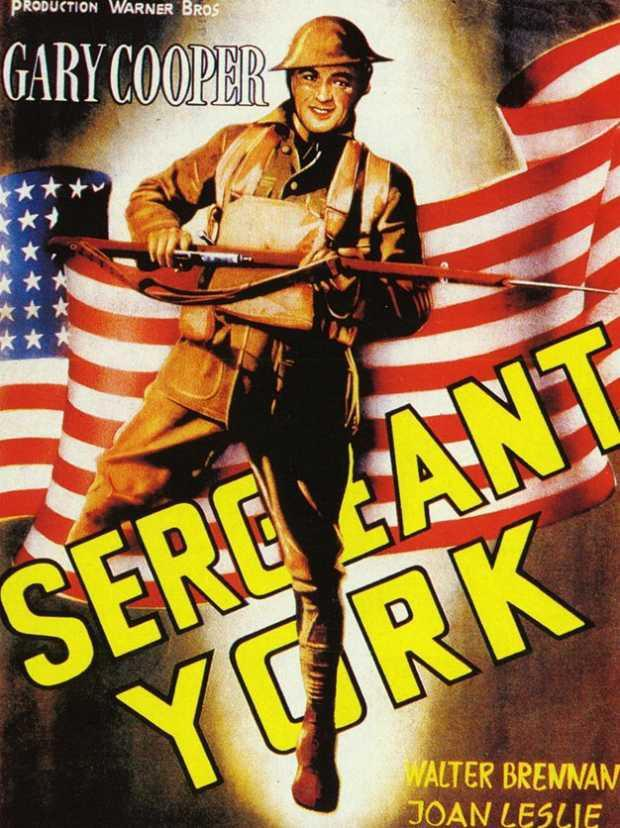
THE STORY OF SGT. YORK
Sgt. Alvin York learned about his area of responsibility within the realm of warfighting. After a life of sin, Alvin York dedicated his life to Christ before being drafted into the Army in WWI. His church had been influenced by the Idealist school of thought, and as such, York considered himself a pacifist, unable to fight.
However, God blessed York with two Christian senior officers, Capt. E.C.B. Danforth and Maj. G. Edward Buxton, who invited York to discuss the Bible’s view on warfighting and killing in depth, not “as a battalion commander discussing it with an officer and a private. He wanted to discuss it as three American citizens interested in a common cause. He said he respected any honest religious conviction and would be glad to discuss things as man to man.”[46]
After hours of comparing Bible verses, Capt. Danforth showed York the passage that helped him understand what was and what wasn’t his responsibility in wartime. York read Ezekiel 33:1-6:
“Again the word of the Lord came to me, saying ‘Son of Man, speak to the children of your people, and say to them: “When I bring the sword upon a land, and the people of the land take a man from their territory and make him their watchman, when he sees the sword coming upon the land, if he blows the trumpet and warns the people, then whoever hears the sound of the trumpet and does not take warning, if the sword comes and takes him away, his blood shall be on his own head. He heard the sound of the trumpet, but did not take warning; his blood shall be upon himself. But he who takes warning will save his life. But if the watchman sees the sword coming and does not blow the trumpet, and the people are not warned, and the sword comes and takes any person from among them, he is taken away in his iniquity; but his blood I will require at the watchman’s hand.”[47]
This verse changed York’s life. He understood that in combat, armed struggle between two people resulting in the death of one, his responsibility was squarely with himself and his group. It did not lay with the enemy combatant. That was the enemy combatant’s responsibility. He understood that the dynamics we have seen laid out by the Stoics, who though Gentiles, had the Law of God written on their hearts as told in Romans 1: 20 and 2:14-15, were found in the very Bible. He understood that God commanded these responsibilities in Judges 3:1-4, and celebrated living them out in Hebrews 1:1-2, 32-34, 39!
And so, upon discovering these things, Sgt. York wrote to his mother, “I am going to war with sword of the Lord and of Gideon [Hero of Judges]…. I have received my assurance. I have received it from God himself–that it’s right for me to go to war, and that as long as I believe in Him, not one hair of my head will be harmed.”[48]
As Vietnam War Medal of Honor winner Col. Jack Jacobs eloquently observed:
“If I am not for myself, who will be for me?
“And if I am only for myself, then what am I?
“And if not now, when?”[49]
Or as General George S. Patton more bluntly put it:
“No b— ever won a war by dying for his country. He won it by making the other poor dumb b— die for his.”[50]
That’s how Sgt. Alvin York won the Medal of Honor.
DYNAMICS OF THE FIGHT
That term Medal of Honor brings up an interesting question.
What does it mean? What is Honor and what role does it play in wartime? Why do we as Americans give our highest wartime medal (remember Lemay: “You’ve got to kill people, and when you kill enough of them, they stop fighting.”[51]) the name “Honor?”
It is only through an understanding of Honor that we can truly understand the intimate dynamics of the close fight. Doing so pays respect to the warfighter, and allows us to become more proficient to protect the innocent, fulfilling Stockdale, York, Jacobs, and Patton’s mandate.
With our Biblical and Philosophical basis already established, it is time we understand the works of one more Classical author and historian: Thucydides.
Thucydides’ opus magnum, The History of the Peloponnesian War is a military, political, and historical classic. Its penetrating insight into human nature and warfighting comes from his intimate experience with it.
An Athenian General in the 30 year Peloponnesian War between Athens and Sparta, Thucydides fought for Athens before being scapegoated out of the Army for the defeat at the Battle of Amphipolis. This left him decades to observe the conflict from both sides, researching first-hand The History of the Peloponnesian War.[52] As one reviewer of Thucydides work notes:
“It is no accident that there is little naiveté, much less idealism and innocence, to be found in the black-and-white history of Thucydides…Its author, we must remember, was above all a man of action, an elected official, a captain, a traveler, a pragmatic intellectual, a successful combatant against warrior and disease alike, hardbitten and intimate with both privilege and disgrace, a man who suffered with and outlived most of the greatest men of his age.”[53]
Two passages within Thucydides are vital for understanding warfighting.
The first passage comes from Archidamus, King of the Spartans. Found in Book I.84, he proclaims, “We are…brave in war, because self-control is the chief element in self-respect, and respect of self, in turn, is the chief element in courage.”[54]
The second passage comes from Pericles, King of the Athenians. Found in Book 2.43, he proclaims, “Do you, therefore, now make these men your examples, and judging freedom to the be happiness and courage to be freedom, be not too anxious about the dangers of war.”[55]
Taken together, these two quotes constitute the Thucydidian Equation for Courage: S2CFH:
- Self-Respect leads to…
- Self-Control creating…
- Courage in the face of danger allowing for…
- Freedom which leads to the emotion of…
- Happiness
The key operative in this equation is the term Self-Respect. This is a contextual translation of the Greek word Doxa, meaning Honor. Honor is defined by the classicist Donald Kagan as “deference, esteem, just due, regard, respect, or prestige.”[56]
Honor, or Respect, only functions in what culture critic Jack Donovan refers to as a hierarchy. “If everyone is honored equally, and everyone’s way of life is honored equally, honor has no hierarchy, and therefore, honor has little value…” Donovan writes. “If honor is to mean anything at all, it must be hierarchical.”[57]
In essence, then, the struggle for Honor becomes a competition of values between two parties. Tom Rath, New York Times #1 Bestselling Author, leading Business thinker, and the associate of the late psychologist Don Clifton, observed that, “Competition is rooted in comparison…If you can compare, you can compete, and if you can compete, you can win.”[58]
This means that in the context of S2CFC, this translates into Honor or value toward self, in modern English, Self-Respect.
Syllogistically in Aristotelian logic, this becomes Man Honors Self. Man is the subject term, Honor is the linking verb, and self is the predicate term.
Essentially, battle becomes a contest of Honor between combatants. Whichever combatant Honors/Respects himself more wins, or dies trying. This is the same understanding found in 1 Timothy 5:8 “But if anyone does not provide for his own, and especially for those of his household, he has denied the faith and is worse than an unbeliever.”
In order to do this, each combatant must have Control over Self to direct force against his enemy. This includes Moral, Mental, and Physical Self-Control.
Moral in this context means willpower: you Honor/Respect yourself so highly you have the willpower to fuel you to win. Mental means outthinking the enemy: observing, orienting, deciding, and acting faster and more effectively than he can. Physical is the actual act of killing, putting your Moral and Mental Self-Control into action to destroy the enemy and preserve your own life.
Mastering Self-Control leads to Courage. Alternatively translated as Bravery and Valor, it is the Confidence in the Self to beat the enemy, overcoming fear of death.[59]
This leads to Freedom, defined by legendary Col. John Boyd as, “…survival, more importantly survival on our own terms. Naturally, such a notion implies that we should be able to act free or independently of any debilitating external influences otherwise that very survival might be in jeopardy.”[60]
By killing the enemy, you eliminate the debilitating external influences. This leads to a state of Happiness.
Understanding this can allow us to understand Thucydides’ equation for Human Nature. Found in Book 2.43, it consists of:
- Honor
- Fear
- Self-Interest
This is a sequential equation. Because a person Honors himself, when he is threatened by his enemy Fear is induced. His response to Fear, in a person who possesses Moral, Mental, and Physical Self-Control will be Courage. This Courage is manifested in Anger that the self that you Honor is threatened. Col Jeff Cooper was a combat Marine in the Pacific Theatre during WWII. He rhetorically asked:
“Now how do we calculate an aggressive response? I think the answer is indignation…They have no right to offer you violence. They are bad people and you are quite justified in resenting their behavior to the point of rage. Your response, if attacked, must not be fear, it must be anger. The two emotions are very close and you can quite easily turn one into the other. At this point, your life hangs upon your ability to block out all thoughts of your own peril, and concentrate utterly upon the destruction of your enemy. Anger lets you do this.”[61]
This Anger, the manifestation of Courage, backed up by Moral, Mental, and Physical Self-Control for the purpose of Honor of the self, leads to actions based within Self-Interest. This is combat, the close fight, resulting in the death of your enemy.
How does this play out in reality?
When Fear sets in, initiates the adrenaline-flooding Fight-or-Flight response. One Afghanistan veteran summarized this incredible adrenaline rush: “There is nothing like [combat], nothing in the world. If it’s negative twenty degrees outside, you’re sweating, if it’s a hundred and twenty, you’re cold…It’s an adrenaline rush you can’t imagine.”[62]
Vietnam veteran James Webb recalled slogging through the jungle, anticipating the close fight. “Already weary and yet crack-high on adrenaline, we waded slowly across the turgid river in the darkness…”[63]
Upon making contact with the enemy, the ultimate contest for Honor is on.
PFC James Hebron recalled the exhilaration of, “That sense of power, of looking down the barrel of a rifle at some-body and saying, ‘Wow, I can drill this guy.’ Doing it is something else too. You don’t necessarily feel bad; you feel proud, especially if it’s one on one, he has a chance. It’s the throw of the hat. It’s the thrill of the hunt.”[64]
At the end of it all, the battle won, Freedom preserved, a Happiness takes over, recalled Vietnam combat veteran William Broyle. Upon seeing the enemy dead, he felt, “..the exultant realization that he whoever he had been —was dead— and I— special unique me—was alive.”[65]
This the reality of combat. While our Idealist society that denies the unity of Freedom and Nature demonizes this reality, Navy SEAL and humanitarian worker Eric Greitens summed it best when he rhetorically asked a fellow SEAL:
“How many guys do you know who said this about combat: ‘I don’t know if I’ll ever feel that alive again’? Any honest account of the experience of combat has to make room for the experience–even joy–of absolute engagement, the electric sensation of knowing that everything matters.”[66]
A CALL TO ARMS
To preserve “Life, Liberty, and the Pursuit of Happiness” in America–
our Freedom—we cannot ignore reality by rejecting Nature. That will not
win us Freedom. That will win us death.
Only by embracing Nature, and recognizing our proper place in it as human beings made in the Image of God, can we win Freedom. By recognizing our realm of responsibility, as 1 Timothy 5:8 tells us, can we win Freedom. “But if anyone does not provide for his own, and especially for those of his household, he has denied the faith and is worse than an unbeliever.” Only by answering the command of Judges 3:1-4 and celebrating it as in Hebrews 11:1-2, 32-34, 39 can we be free.
Only by embracing this doctrine commanded to us can we “Defend the poor and the fatherless; Do justice to the afflicted and needy. Deliver the poor and the needy; Free them from the hand of the wicked” as Psalms 82:4 exhorts. Only then can we “Learn to do good; Seek justice, Rebuke the oppressor; Defend the fatherless, Plead for the widow” as Isaiah 1:17 commands.
Only Honoring and Controlling the Self can we have Courage to win Freedom, and only then can we achieve the Pursuit of Happiness. You have to be alive to be Free, temporally and spiritually. You have to be alive to accept the Free Gift of Salvation of Jesus Christ and do his works. And if you can’t?
Well, like the Knights Templar of old, you’ve got to die trying.
You die with your boots on.
In these dark days, the world is depending on a strong America. The world is depending on a Free America. Richard Wurmbrand, tortured for Christ by the Communists in Romania, sums it up best:
“Every freedom-loving man has two fatherlands; his own and America. Today, America is the hope of every enslaved man, because it is the last bastion of freedom in the world. Only America has the power and spiritual resources to stand as a barrier between militant communism and the people of the world.
“It is the last ‘dike’ holding back the rampaging flood of militant communism. If it crumples, there is no other dike, no other dam; no other line of defense to fall back upon.
“America is the last hope of millions of enslaved people. They look to it as their second fatherland. In it lies their hopes and prayers.
“I have seen fellow-prisoners in communists prisons beaten, tortured, with 50 pounds of chains on their legs praying for America… that the dike will not crumple; that it will remain free.”[67]
Our enemies’ names change. The story remains the same.
The world is looking to us.
Live and Let Die.
Kill like a Christian.
Sincerely,
Richard Barrett
11-16-2025; 11-11-2025; 06-25-2021; 10-2016
Re-created here on 11-16-2025, at 5:39 PM, somewhere in the USA…
Sources Cited
[1] Lawrence, T.E. “T.E. Lawrence.” Goodreads, accessed October 16, 2016, http://www.goodreads.com/quotes/626217-i-loved-you-so-i-drew-these-tides-Of-men.
[2] Botev, Hristo “My Prayer.” Virtual Library of Bulgarian Literature “Slovoto”!, accessed October 16, 2016, http://www.slovo.bg/old/f/en/botev/.
[3] Donovan, David. Once a Warrior King: Memories of An Officer in Vietnam. (New York: Ballantine Books, 1985). 331.
[4] Ibrahim, Raymond. “Christian Slaughter in Libya.” Raymond Ibrahim, February 5, 2015, accessed October 16, 2016, https://raymondibrahim.com/02/16/2015/christian-slaughter-in-libya/.
[5] “Terrorists Commit Massacre in al-Zara Town in Hama Countryside, Cabinet Condemns Atrocity.” Syrian Arab News Agency, May 12, 2016, accessed October 16, 2016, http://sana.sy/en/?p=77063; “Islamic State (IS) Enters Syrian town and brutally kill Christians and Alawites, whilst continued fighting in Aleppo during truce results in more deaths and injuries.” Barnabasaid, May 19, 2016, accessed October 16, 2016, https://barnabasfund.org/news/lslamic-State-IS-enter-Syrian-town-and-brutally-kill-Christians-and-Alawites-whilst-continued-fighting-in-Aleppo-during-truce-results-in-more-deaths-and-injuries.
[6] Ibrahim, Raymond. “Christians as ‘Target Practice’: Muslim Persecution of Christians: May 2016.” August 29, 2016, accessed October 16, 2016, http://raymondibrahim.com/2016/08/29/christians-as-target-practice-muslim-persecution-of-christians-may-2016/.
[7] Kozak, Warren. Lemay: The Life and Wars of General Curtis Lemay. (Washington, DC: Regnery Publishing, Inc., 2009). ix-xiii, 121-124.
[8] Ibid. xi.
[9] Schaffer, Francis A. Escape From Reason. (Downers Grove, IL: Inter Varsity Press, 1968). 43-50, 53-59.
[10] Schiller, Friedrich. “On the Sublime (1801).” Philosophy Project, accessed October 16, 2016, http://philosophyproject.org/wp-content/uploads/2013/04/On-the-Sublime-Schiller.pdf.
[11] Ibid. 1-2.
[12] Ilyin, Ivan. “Ivan Ilyin, ‘The idea of Kornilov.’” Free Republic, June 17, 1925, published June 22, 2013, accessed October 16, 2016, http://www.freerepublic.com/focus/f-bloggers/3034357/posts.
[13] Abrams, M.H., and Geoffrey Galt Harpham. A Glossary of Literary Terms. (Stamford, CT: Cengage Learning, 2015). 155-156.
[14] Rand, Ayn. “Philosophy: Who Needs It?” Ayn Rand Institute, 1974, accessed October 16, 2016, https://campus.aynrand.org/campus/globals/transcripts/philosophy-who-needs-it.
[15] Grossman, Lt. Col. Dave. “Psychological Effects of Combat.” Killology Research Group, accessed October 16, 2016, http://www.killology.com/psychological-effects-of-combat. Grossman, Lt. Col. David, and B.K. Siddle, “Psychological Effects in Combat,” in Encyclopedia of Violence, Peace, and Conflict. (Cambridge, MA: Academic Press, 2000); Grossman, Lt. Col. David. “On Wolves, Sheeps, and Sheepdogs.” Killology Research Group, accessed October 16, 2016, http://www.killology.com/sheep-wolves-and-sheepdogs. From Grossman, Lt. Col. Dave and Loren Christenson. On Combat: The Psychology and Physiology of Deadly Conflict in War and Peace. (Mascoutah, IL: 2004).
[16] Schultz Jr., Richard H. and Andrea J. Dew. Insurgents, Terrorists, and Militias: The Warriors of Contemporary Combat. (New York: Columbia University Press, 2005). 40-54.
[17] Boot, Max. Invisible Armies: An Epic History of Guerrilla Warfare From Ancient Times to the Present. (New York: Liveright Publishing Corporation, A Division of W.W. Norton & Company, 2013) 10-12.
[18] For an in-depth critique of Lt. Dave Grossman’s conclusions and research sources, see Engen, Robert. “Killing For Their Country: A New Look at ‘Killology,’” Canadian Military Journal 9, no. 2 (Archived on July 21, 2011). https://web.archive.org/web/20110721211742/http://www.journal.dnd.ca/vo9/no2/16-engen-eng.asp. For Grossman’s response to Engen, see Grossman, Dave. “SLA Marshall Revisited..?” Canadian Military Journal 9, no. 4. http://www.journal.forces.gc.ca/vo9/no4/18-grossman-eng.asp. For further critique of Grossman’s conclusions and research sources, also see Aveni, Thomas J. “SLA Marshall’s ‘Men Against Fire,’” theppsc.org (The Police Policy Studies Council), accessed June 21, 2021, http://www.theppsc.org/Grossman/SLA_Marshall/Main.htm. Also see Chambers II, John Whiteclay S. L. A. Marshall’s Men Against Fire: New Evidence Regarding Fire Ratios. theppsc.org, (The Police Policy Studies Council), 2003, accessed June 21, 2021, http://www.theppsc.org/Grossman/SLA_Marshall/Bad-Firing-Data.htm.
[19] Bradford, Alfred S. Some Even Volunteered: The First Wolfhounds Pacify Vietnam. (Westport, CT: Praeger Publishers, 1994). 183.
[20] Karsh, Efraim, and Inari Rautsi. Saddam Hussein: A Political Biography. (New York: The Free Press, 1991). 10.
[21] Kozak, Warren. Lemay: The Life and Wars of General Curtis Lemay. (Washington, DC: Regnery Publishing, Inc., 2009). xi.
[22] Brown, Rabbi Randy. “Is War Kosher”? Lecture, Marine Corps University, Quantico, VA: February 20, 2017.
[23] Brown, Rabbi Randy. “Is War Kosher”? Lecture, Marine Corps University, Quantico, VA: February 20, 2017.
[24] For sources on the Knights Templar, see Nicholson, Helen. Knights Templar: 1120-1312. (Oxford, UK: Osprey Publishing, 2004). See also Campbell, David. Combat: Knights Templar vs. Mamluk Warrior, 1218-50. (Oxford, UK: Osprey Publishing, 2015). See also Frale, Barbara: The Templars: The Secret History Revealed. (New York, NY: Arcade Publishing, 2011). See also Ralls, PhD, Karen. Knights Templar Encyclopedia: The Essential Guide to the People, Places, Events, and Symbols of the Order of the Temple. (Newburyport, MA: Weiser, 2007). For the ideological continuity between the Islamist Saracens of the Crusades and the Jihadists of today, see Barrett, Richard. All Men Follow the Strongman: The Forgotten History of the Iraq War. (CreateSpace, 2015).
[25] Nicholson, Helen. Knights Templar: 1120-1312. (Oxford, UK: Osprey Publishing, 2004). 20-21.
[26] Stockdale, James Bond. Thoughts Of A Philosophical Fighter Pilot. Stanford, CA: Hoover Institution Press, 1995. 18. On the Greco-Romanconnection to Agon, see also Neizsche, Frederich, “Homer’s Competition.” 1872. Retrieved from http://nietzsche.holtof.com/Nietzsche_various/homers_competition.htm. For more on James Bond Stockdale, see Kiland, Taylor Baldwin, and Peter Fretwell. Lessons from the Hanoi Hilton: Six Characteristics of High-Performance Teams. Annapolis, MD: Naval Institute Press, 2013. For Kavash in the Biblical Hebrew Tradition,and its 1:1 correspondence equivalent to Agon, see Moen, Dr. Skip. Guardian Angel: What You Must Know about God’s Design for Women. Abridged Edition. Monroe, IL: Createspace. 2015. Pg 75. For the related concept Yetzer Ha’ra in the Biblical Hebrew Tradition, see Moen, Skip. “Guardian Angel: A postscript.” Hebrew Word Study. February 16, 2017. https://skipmoen.com/2017/02/guardian-angel-a-postscript/. Moen, Skip. “Untranslatable.” Hebrew Word Study. November 30, 2016. https://skipmoen.com/2016/11/untranslatable-3/. Jacobs, Jessica. “So You Have a Yetzer HaRa! A Training Guide for Primitive Breeds.” Lilith.org. October 31, 2019. https://lilith.org/2019/10/so-you-have-a-yetzer-hara-a-training-guide-for-primitive-breeds/. Moen, Skip. “Once Too Often.” Hebrew Word Study. June 29, 2013. https://skipmoen.com/2013/07/once-too-often/. Moen, Skip. “Inclined Plane.” Hebrew Word Study. July 28, 2009. https://skipmoen.com/2009/07/inclined-plane/. Moen, Skip. “Resume”. Hebrew Word Study. December 21, 2011. https://skipmoen.com/2011/12/resume/. Moen, Skip. “Faith in Action.” Hebrew Word Study. August 22, 2009. https://skipmoen.com/2009/08/faith-is-action/. Moen, Skip. “Exit Wound.” Hebrew Word Study. September 24, 2012. https://skipmoen.com/2012/09/exit-wound/. Moen, Skip. “Preparing to Fear”. Hebrew Word Study. September 28, 2009. https://skipmoen.com/2009/09/preparing-to-fear/. Patai, Raphael. The Jewish Mind. New York, NY: Hatherleigh Press, 2007.
[27] Stockdale, James Bond. Thoughts Of A Philosophical Fighter Pilot. Stanford, CA: Hoover Institution Press, 1995. 14-18.
[28] ME Mechanical Team. “Newton’s Laws of Motion.” ME Mechanical. February 2, 2016. https://me-mechanicalengineering.com/newtons-laws-of-motion/. Accessed March 4, 2017.
[29] Stockdale, James Bond. Thoughts Of A Philosophical Fighter Pilot. Stanford, CA: Hoover Institution Press, 1995. 26.
[30] De Sena, Joe. Spartan Fit: 30 Days. Transform Your Mind. Transform Your Body. Commit to Grit. Boston: Houghton Mifflin Harcourt, 2016. Pg. 109. See also Holiday, Ryan. The Obstacle is the Way: The Timeless Art of Turning Trials into Triumph. New York, NY: Portfolio/Penguin. 2014.
[31] See Miner, Thomas. Thomas Aquinas on the Passions: A Study of Summa Theologiae, 1a2ae 22-48. Cambridge, UK: Cambridge University Press, 2011.
[32] Stockdale, James Bond. Thoughts Of A Philosophical Fighter Pilot. Stanford, CA: Hoover Institution Press, 1995. 189.
[33] Burroway, Janet. Writing Fiction: A Guide to Narrative Craft. Boston: Little, Brown and Company, 1982. 5.
[34] For an extended discussion of this topic, see Barrett, Richard and Lafond, James. “Richard Barrett and the Crackpot Mythologist Discuss Our Collective Narrative Depth.” 2020. Retrieved 12, February 2021, from https://www.jameslafond.com/article.php?id=12571. Also see Macdowell, Simon. Germanic Warrior 236-568 AD. London, UK: Osprey Publishing, 1996. Also see Gronbech, Vilhelm. The Culture of the Teutons. London, England. Oxford University Press, 1931. For a summary of the firsthand sources on the the Medieval context, see Chapters 1 and 2 of Horsman, Reginald. Race and Manifest Destiny: The Origins of American Racial Anglo-Saxonism. Cambridge, MA: Harvard University Press. 1981. 9-
42. In the Hebrew context, see Brown, Rabbi Randy. “Is War Kosher”? Lecture, Marine Corps University, Quantico, VA: February 20, 2017.
[35] See the 1975 quote from Los Angeles Times columnist Cecil Smith “Gunsmoke was the dramatization of the American epic legend of the west. Our own Iliad and Odyssey, created from standard elements of the dime novel and the pulp Western as romanticized by [Ned] Buntline, [Bret] Hatre, and [Mark] Twain. It was ever the stuff of legend…Matt Dillon…Miss Kitty… Doc Adams…and Chester… were our Zeus, Aphrodite, Bacchus and limping Mercury.” Quoted in Smith, C. (1975, September 01). Legend Goes Down The Tubes. Los Angeles Times, pp. 39-51. Reproductions of Pages 39 and 59 can be found here (https://www.newspapers.com/clip/31052622/the-los-angeles-times/) and here (https://www.newspapers.com/clip/33007279/a-legend-goes-down-the-tubes-main/) respectively.
[36] See Gunsmoke’s intro perfectly illustrating the Confrontational Warrior Ethos of the West here (https://www.youtube.com/watch?v=qbo6tp4UgII).
[37] Barrett, Richard and Lafond, James. “Arete and Agony: Richard Barrett and James Discuss the Conceptual and Spiritual Aspects of Aryan Warrior Culture.” 2020. Retrieved 01, January, 2021, from https://www.jameslafond.com/article.php?id=12244.
[38] Gronbech, Vilhelm. The Culture of the Teutons. London, England. Oxford University Press, 1931. 6.
[39] Stockdale, James Bond. “Courage Under Fire: Testing Epictetus’ Doctrines in a Laboratory of Human Behavior.” Hoover.org, November 15, 1993, accessed October 16, 2016, http://media.hoover.org/sites/default/files/documents/978-0-8179-3692-1 1.pdf. 3.
[40] Ibid. 1-21.
[41] Stockdale, James Bond. Thoughts Of A Philosophical Fighter Pilot. Stanford, CA: Hoover Institution Press, 1995. 232.
[42] Moore, Lt. Col. Hal. We Were Soldiers Once… And Young. New York, NY: HarperCollins Publishers, Inc. 1993. Xxi.
[43] Epictetus. The Discourses as Reported by Arian, The Manual, and Fragments: In Two Volumes. I.2. Vol. 1. trans. W.A. Oldfather. (Cambridge, MA: Harvard University Press, 1925). 17.
[44] Holiday, Ryan, and Hanselman, Stephen. The Daily Stoic: 366 Meditations on Wisdom, Perseverance, and the Art of Living. New York, NY: Portfolio/Penguin. 2016. 66.
[45] Holiday, Ryan, and Hanselman, Stephen. Lives of the Stoics: The Art of Living from Zeno to Marcus Aurelius. New York, NY: Portfolio/Penguin. 2020. 260.
[46] Mastriano, Douglas V. Alvin York: A New Biography of the Hero of the Argonne. (Lexington KY: The University of Kentucky Press, 2014). 38.
[47] Ibid. 38-41; Kopel, David. “Sergeant York: Great Hero of the Great War.” Dave Kopel, February 2006, accessed October 16, 2016, http://www.davekopel.com/2A/Mags/Sergeant-York.pdf.
[48] Mastriano, Douglas V. Alvin York: A New Biography of the Hero of the Argonne. (Lexington KY: The University of Kentucky Press, 2014). 41.
[49] Jacobs, Col. Jack, and Douglas Century. If Not Now, When? Duty and Sacrifice in America’s Time of Need. (New York: The Berkeley Publishing Group, 2008). 134.
[50] “No B— Ever Won a War by Dying for his Country.” Quote Investigator, April 25, 2014, accessed October 16, 2016, http://quoteinvestigator.com/2015/04/24/war/.
[51] Kozak, Warren. Lemay: The Life and Wars of General Curtis Lemay. (Washington, DC: Regnery Publishing, Inc., 2009). Xi.
[52] Kaplan, Robert D. Warrior Politics: Why Leadership Demands A Pagan Ethos. (New York: Vintage Books, A Division of Random House, Inc., 2002). 44-45.
[53] Strassler, Robert B. Quoted in “Introduction.” Thucydides. The Landmark Thucydides: A Comprehensive Guide to the Peloponnesian War, ed. Robert B. Strassler, trans. (1878) Richard Crawley. (New York: Free Press, 1996). x-xi.
[54] Thucydides. The History of the Peloponnesian War Books I and II. 1.84. Vol. 1, trans. Charles Forster Smith. (Cambridge: Harvard University Press, 1919).
[55] Ibid. 2.43.
[56] Kagan, Donald. On the Origins of War and the Preservation of Peace. New York, NY: Anchor Books, 1995. 8.
[57] Donovan, Jack. The Way of Men. Milwaukie, OR: Dissonant Hum. 2012. 53-54.
[58] Rath, Tom. Strength Finder 2.0. New York, NY: Gallup Press, 2007. 69.
[59] For more on Courage, see Kidder, Rushworth M. Moral Courage: Taking Action When Your Values are Put to the Test. New York, NY: HarperCollins Publishers, 2005. See also Aquinas, Thomas. “Summa Theologica: Secunda Secundae Partis, Q. 123.” New Advent. http://www.newadvent.org/summa/3123.htm. Accessed December 16, 2017. See also Aquinas, Thomas. “Summa Theologica: Prima Secundae Partis, Q. 45.” New Advent. http://www.newadvent.org/summa/2045.htm. Accessed December 16, 2017. See Miner, Thomas. Thomas Aquinas on the Passions: A Study of Summa Theologiae, 1a2ae 22-48. Cambridge, UK: Cambridge University Press, 2011.
[60] Boyd, John. “Destruction and Creation.” The John Boyd Library, September 3, 1976, published February 2016, accessed October 15, 2016, http://danford.net/boyd/destruct.htm.
[61] Cooper, Jeff. Principles of Personal Protection. (Boulder, CO: Paladin Press, 1989). 21.
[62] Chrisinger, David. “Combat and the Timeless Pull to Return.” Stronger at the Broken Places, August 8, 2014, accessed October 15, 2016, http://strongeratthebrokenplaces.com/combat-and-the-timeless-pull-to-return/.
[63] Webb, James. I Heard My Country Calling: A Memoir. (New York: Simon and Schuster, 2014). 281.
[64] Bourke, Joanna. An Intimate History of Killing: Face to Face Killing in 20th Century Warfare. (New York: Basic Books 1999). 20.
[65] Ibid. 3.
[66] Greitens, Eric. Resilience: Hard-Won Wisdom for Living a Better Life. (New York: Mariner Books, Houghton Mifflin Harcourt, 2015). 270.
[67] The American Patriot’s Bible: The Word of God and the Shaping of America. Ed. Dr. Richard G. Lee. (Nashville, TN: Thomas Nelson, 2009). 576.
 PULP FICTION RENAISSANCE