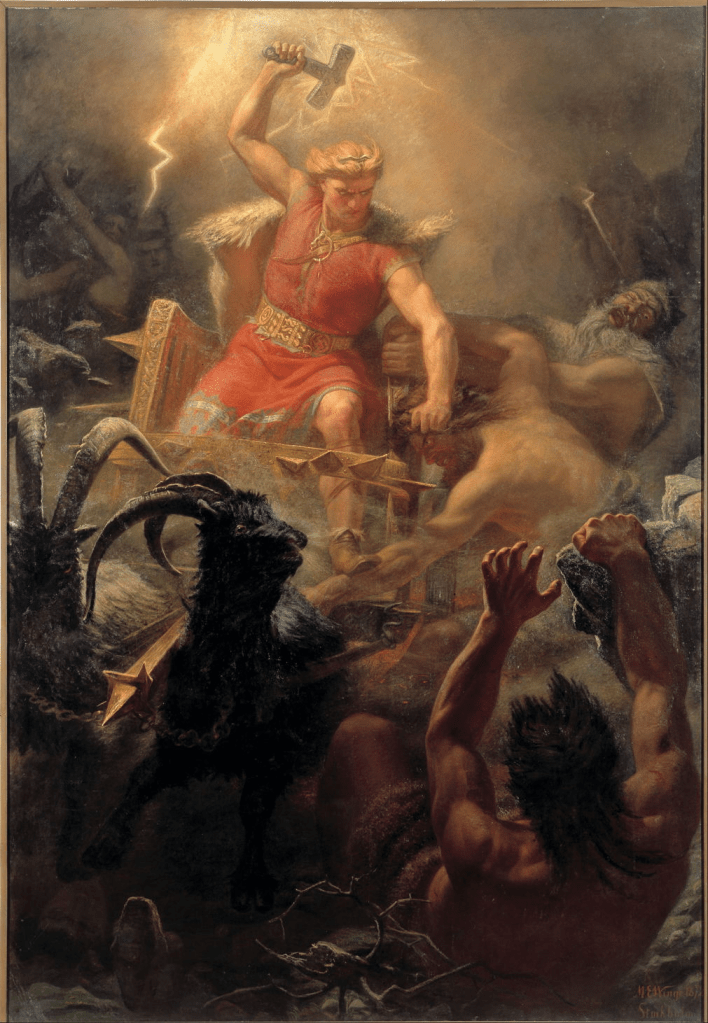
If you live in Western Civilization, then you probably know all about WWII.
And whether you like to play for the Axis or the Allies, the broad strokes of the conflict are pretty clear.
But what if WWII…and even WWI…had been prophesied in Ancient Indo-European Mythology?
Enter in Wulf Ingessenu, English Magician par excellence!
We got such a great response from Wulf’s last guest post, “Thule vs. At-al-Land”, that we decided to provide his exclusive sequel here, with his permission of course!
Originally written on January 22nd, 2025, Wulf reveals how well-known 20th Century History has been foretold in the Myths of the Germanic Peoples thousands of years ago…
Proving once and for all what King Solomon famously said in Ephesians 1:9, NIV:
“What has been will be again, what has been done will be done again; there is nothing new under the sun.”
So without further adieu, I give you…
WAR OF THE GODS
THE ARCHETYPAL MYTH
By Wulf Ingessenu
January 22nd, 2025
This follows on from ‘Thule vs. At-al-land’, taking this back to the reason why the Æsir and Waene fought against each other. After I had finished the work on World War I and World War II it struck me that I had not actually covered the original cause in the Norse Myth. (I think I blamed Loki for this, but this is not so – we could blame him anyway!) It also occurred to me that Viktor Rydberg’s work was based around conflicts between the Gods, and this is something that needs some more study. Some people dismiss Rydberg but his view of Germanic Myth is far more useful that much of the mainstream stuff, since the latter really does not put any sequence or meaning, it just relates the myths in a form of ‘children’s tale’ or ‘fairy tale’. We need to state clearly that myth is Eternal Truth, and the Archetypal Myths are the underlying pattern behind historical events, and the unfolding of history.
LOKI THE TRICKSTER
Loki is not one of the Gods, but at some stage he became blood-brother to Woden; we do not know when and how, but sharing blood meant that he took blood-kinship with Woden. Loki is a being that plays tricks, and at first he is really like an ‘Innocent Fool’, and some of his works do bad, some do good. As time goes on he becomes progressively more evil, and he is the cause of the War of the Elves, even if this was not done consciously. The last straw is his role in the slaying of the Sun-God, Bældaeg, even though it was the brother of Bældæg, Blind Hodr, that does the evil act. For this he is caught and bound. Loki is the Evil Principle. The name ‘Loki’ is related to the Spider’s Web (we’ll not go into this here) and it is Loki that birth’s Woden’s Horse, Sleipnir – the Eight-Legged Steed. There are reasons to think that this Eight-Legged Steed is thus related to the Web of Wyrd (Spider’s Web), since the ‘Steed of Woden’ is also named Iggdrasil – the White Tree or World Tree. Iggdrasil, at one level, is the Milky Way Galaxy. To the Saxons this was the Irminsul, which is why this is depicted as a column with two arms, which is how the Milky Way Galaxy can be seen. Ir-Min-Sul is the ‘Column of Irmin’ whose alternative is ‘Ar-Man’; this is the ‘God of the Aryans’ (Aryaman). In one myth Loki turns himself into a ‘stinging-creature’ which could be the Spider. The Eight-Legged Steed is sometimes seen as the Divine Horse with four legs in this dimension and four legs in the other dimension, thus moving through the two worlds at the same time. This is just one suggestion.
The Web of Wyrd can be seen as the concept recently rediscovered by quantum physics, that there is an inter-connected network of ‘threads’ that spans the universe. Thus, the idea that we should all have a responsibility as to our actions, since any given action at any point of the ‘web’ affects the whole, and thus affects everyone and everything. In his book ‘The Way of Wyrd’ Brian Bates goes into this, but through the agency of fiction. The book is strongly based around ideas from the work of Carlos Castaneda, and this is projected onto the theme of the Wyrd. This is not the place to go into this here, but the ‘World Wide Web’ is a material parody of the ‘Web of Wyrd, and we can attribute this to the work of Loki – it has been likened to a ‘Spider’s Web’.
Loki is the ‘Enemy Within’, since he is always with the Gods, and he always dwells amongst our Folk here in Middle-Earth. It is Loki that creates the ‘Trojan Horse’ in which the hordes of outlanders are brought into the Homeland of the Folk, and it is Loki that leads the Joten (of which race he is really) against the Gods at Ragnarok. But we have another side to Loki that needs to be looked at, since he can be seen as the Male Evil Principle, but in fact he is androgyne, and he also increases the Female Evil Principle within himself.
THE SLAYING OF GULLVEIG
For a fuller account of this I can only suggest that Viktor Rydberg’s ‘Teutonic Mythology’ be read carefully. His work, like any that works on a more esoteric level, needs to be studied over and over again to bring up new ideas. He shows the real nature of Loki, but he also shows that Gullveig is the ‘feminine counterpart’ of Loki the Joten. Gullveig was also present amongst the Gods, but also manifested in Middle-Earth as a Dark Sorceress and Seeress named Heid. The name ‘Gullveig’ is linked to ‘gold’ and thus some have tried to see Gullveig and Heid as Freya, who shed ‘tears of gold’. Of course, we need to have these type of ‘blurs’ in our myth in order to be able to sort of which is the truth. But I cannot see the Goddess Freya as Gullveig! This seems to be like those who equate Woden with Loki.
The Æsir-Gods decided to burn Gullveig as a ‘witch’, which they did three times, and each time she arose from the ashes. There are two things from this, and one is that the burning of witches seems to have predated the Christian pastime, and it seems that burning was the means to destroy this form of evil. The second is that, although Gullveig is said to have arisen from the fires we are told that Loki ate the burnt-heart, The heart is linked to the Soul (‘Heart and Soul’), and thus Loki took into himself the ‘Soul of Gullveig’ – the Female Evil Principle. This slaying of Gullveig took place in Valhalla, the Home of the Æsir-Gods. As the Dark Sorceress or Dark Witch she appears in Middle-Earth ‘encouraging the evil passions of mankind’. Somehow, the Waen seemed to ‘piss-off’ Woden at the council where compensation was demanded of the Æsir, and he threw his Spear over the Waene to declare war! Thus started the War of the Gods.
The prime factor in this seems to be the crime of using Dark Sorcery and Dark Witchcraft, something that is obviously detrimental in its form. Rydberg recounts for us a tale in which Woden uses Dark Sorcery on the Giantess Rind in order to woo her to birth a son (Wali) to avenge the death of Bældæg. For this he is banished from his Divine Seat, but later reinstated because his leadership is sorely needed. The first thing he does as the ‘Father of the Gods’ is to banish Dark Sorcery and Dark Witchcraft from both Asgard and Midgard. (Our gods are, like us, not perfect, and they too strive towards perfection.)
Rydberg shows that Gullveig is Aurboda and Angrboda, the latter being the ‘Ancient One in the Ironwood’. It is Angrboda who births Fenris and the Wargs; Angrboda is the ‘Mother of Werewolves’. Thus, Gullveig lived after the thrice-burning and fled to the East where she swawned the ‘Brood of Fenrir’. The daughter of Loki is not Hel (Hela), this is a distortion using the idea of the Christian ‘Hell’, since Hel has a light and dark side, and is the ‘Realm of the Dead’. Hel seems to be Wyrd. The ‘Ancient One of the Ironwood’ (Angrboda) seems to be behind the legend of the ‘Huns’ of Attila, who were said to be ‘Helruna’; the Huns were here said to be the offspring of these Helruna. She, and her brood, are also seen as the ‘Hordes of the East’ that the Germans always saw as a threat to Europe. The name ‘Fenris’ means ‘Wolf of the Fens’ and it is no coincidence that the ‘Fens’ are in the East of England. The name ‘Fenris’ was associated with the name ‘Grendel’ in the Robin of Sherwood TV series. In Beowulf Grendel is associated with Cain – the brother-slayer.
Gullveig seems to be in some way related to the Waene-Gods, though, like Loki, she may have been dwelling in Vanaheim. Woden is God-Kin, whilst Loki is Joten-Kin, but their blood-bond ties them together, and this may also have been true of Gullveig. She may well have been close to Freya since Freya taught Seidr-Witchcraft to Woden – not that this is ‘Dark Sorcery’, as far as we know. The point of this part of the myth is that her essence was taken in by Loki.
THE DEATH OF BÆLDÆG
Loki is responsible for the death of Bældæg; it is Blind Hodr that actually hurls the dart at the Sun-God, but it is Loki who taunts him to do so, and Hodr is blind so he cannot see what is going on. Bældæg goes to the Nether-World where he dwells in Odainsacre, a place of Light and Perfection that cannot be touched by the Evil Powers. He awaits his resurrection after Ragnarok, where he returns hand-in-hand with his brother, Hodr. The name ‘Balder’ (Norse) can refer to ‘Light’, and the name ‘Hodr’ can be seen as ‘Hood’, a kenning for ‘Darkness’. The roots of the name ‘Balder’ are –
IE Root *bhel– meaning ‘to blow’ ‘to swell’ referring mainly a a ‘round object’. Balder means ‘Brave’.
IE Root *bhel– meaning ‘to shine’. ‘to flash’, ‘to burn’, ‘shining white’. Of interest here is that this is related to roots meaning ‘blue’. It is also related to roots meaning ‘blind’.
IE Root *bhel– meaning ‘to shine’, ‘to flash’, with a form *bhlog– meaning ‘black’, but specifically in the sense of ‘burnt’.
I have taken these roots from ‘The American Heritage Dictionary of Indo-European Roots’ but have not separated each meaning that has the same root, since to me the ‘sound’ is the key thing in working out meanings.
These meanings seem to relate to the Sun as ‘shining’ and ‘white’, but they could equally refer to the Black Sun as being ‘blackened by fire’ (burnt). That Bældæg, unlike the classical gods, does not go through a daily ‘Death and Resurrection’ (0f the Sun), but is slain by the whiles of Loki and is resurrected after Ragnarok seems to infer that he is not the Golden Sun. I have shown how the Fylfot-Swastika is linked to Bældæg through the Merseburg Charm, and this seems to show that the Fylfot is the symbol of Bældæg in the Underworld. (I’ll look at this again here, even though it is repeating it again). Now, Loki has been linked to Saturn (Saturday is ‘Loki’s Day’), but Saturn is the God of the Golden Age. So this does not make any sense. However, Miguel Serrano’s weltanschauung states that Saturn was imprisoned by the Demiurge and that the freeing of Saturn (Rings of Saturn?) is the aim in the renewal & regeneration. This seems to be his take on this being the ‘Lead Age’, where lead is the metal of Saturn (I think); the ‘Lead Age’ is thus transmuted to the Golden Age (Alchemy). The Black Sun is also said to be linked to Saturn (and the Golden Age), and thus Bældæg would also be linked to Saturn. This could explain the ‘slaying of Bældæg’ whose energies were then stolen by Loki the Joten.
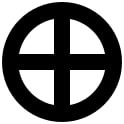
Bældæg’s Ring – the Solar-Wheel
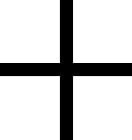
The Solar-Cross, sometimes seen as the Black Sun (it is black). This is the ‘Foal of Bældæg’.
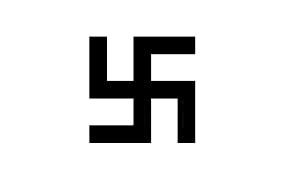
Loki (“Witch of the Eclipse”) breaks the feet of Bældæg’s Foal, thus making the Fylfot-Swastika – the ‘Foal’s Foot’.
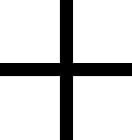
The Goddesses try to charm the Foal’s Feet’ back to right, but cannot do so; Woden – the God of Healing – charms the ‘Foal’s Foot’ back to right, and the Fylfot becomes the Solar-Cross.

Bældæg’s Ring is returned, and he can thus fly into the skies again as he did before.
We can see from this that the Fylfot-Swastika is the Black Sun (Bældæg) which is held ‘captive’ in the Nether-World (Hela). To underline that Bældæg is linked to the Polar Mythos and to the Pole Star originally, the name used in the Merseburg Charms (Old Saxon Text) is Pol – ‘Pole’. That ‘Pole’ and ‘Pol’ may well be the same can be seen in the name of the village that I live in –‘Polegate’ (Gate to the Pole), whose original spelling was ‘Polgate’. (This is rendered ‘pool-gate’, but how this links to ‘gate’ is anyone’s guess – and this is no doubt a ‘guess’ which goes down into the books as ‘fact’.) Thus Bældæg would be the ‘God of the Golden Age’.
That Bældæg and Hodr return hand-in-hand after Ragnarok seems to infer that both are linked to the Black Sun. There is also the problem of Hodr as being ‘blind’ since this is an attribute always linked to Woden. Woden’s power is derived from the Black Sun – the Swastika. That Bældæg is linked to the idea of ‘burnt’ is also significant, since the Black Sun is seen as a burnt-out sun because its power was lost after the ‘Death of the Sun-God’. Its power has always been there but the gateway to that power has been lost through the Cycle of the Ages. It is probably true to say that the ‘Chaining of Saturn’ has stopped the Power of the Black Sun in our Solar-System. One of the forms of the Black Sun is that it shines over the Inner Earth, and it shines over Thule which was situated in the Other-World. There is a piece in the Norse Eddas that tells of a ‘New Sun’ appearing after Ragnarok
Thus, Bældæg is a ‘Sun-God’ but he is the God of the Black Sun and not the Golden Sun. The Sun in Germania is feminine (Sunna) but the rays of the Sun, hitting the Earth, are seen as masculine. Ingwe seems to have taken on the role of the Golden Sun’s Power (Rays), hence his connection to At-al-land and the Western Cycle. But as the Power of the Golden Sun wanes Ingwe is ‘resurrected’ in his Ur-Form as linked to Thule and the Black Sun. His role as ‘God of Fire and Light’ is thus linked to the ‘Divine Fire’ within the Sacred Blood, the Fire of the Black Sun that is the Divine Spark within the Arya. This would also explain why – as Sceaf – he was sent by the Gods to Scandi at the end of the Golden Age, to aid the Folk as the Great Winter approached. One of the things he brought to the Ingefolk was the Divine Fire. That Ingwe has a connection to the Black Sun seems to be seen in the 1999 Solar Eclipse, where the ‘Black Sun’ was said (by Nostradamus) to have ‘brought back to life’ (resurrected) the ‘King of Angolmois’ (Ingwe). We can thus connect King Ar-Thur to the Black Sun – maybe that is why I unconsciously used the spelling ‘Ar-Thur’, ‘AR’ being the Black Sun.
The underlying cause of the War of the Gods was the slaying of Gullveig, which in itself had the negative consequence of Loki becoming even more powerful in the Dark Arts by eating the heart of Gullveig-Aurboda. The Archetypal Myth is played out in the two world-wars, but this part does not (as yet) seem to be involved. However, over the past few decades the rise in ‘feminism’ and the feminine-current, which is a totally false current where women seek to emulate men, but only in taking on the worst traits of men. With the early rise of feminism there was a strong undercurrent of support from the ‘pagan’ world which has focussed on ‘The Goddess’ and written out the masculine altogether. This is nothing new, and arose as a subversion in ancient times, which we see in much of the Southern and Eastern ‘myths’. Much of ‘Wicce’ is like this, though not all of it is so, even though the word ‘wicce’ (which should be sounded ‘witcher’) is masculine.
This increase in the Feminine Evil took place just before the ‘War of the Gods’, and it can be no coincidence that Berlin was the centre of sexual degeneracy and perversion in the years between the wars. The first ‘sex-change’ clinics were opened there, a herald of what has come about in our own era. Germany was getting into the same state as the dying Roman Empire and the European Nations today. This tells us we too are on the brink of major change. Thus, the Myth of Gullveig could be said to have been part of this historical era.
Since these two world wars took place in the early Twentieth Century I suppose we could see the Myth of Gullveig being enacted in the sense of arising in the East as the force behind Russian Communism, especially since this was after Loki took in her Evil Essence. Loki seems to have taken a key role in the Russian Revolution, and certainly the key role in founding Marxist Communism. Looked at this way maybe this whole myth was the current behind these world events. Nothing can be proved, but we should keep this in mind.
The one thing that seems to show how the power of the Golden Sun, and the Western Mythos, is in decline, is that the New Age is seen as the ‘Age of Magic’ and that the ‘Age of Reason’ is passing. This is because of the Cycle of the Ages where mankind is evolving towards a higher state of consciousness, and the opening of the ‘Psychic Eye’. The loss of the powers of the ‘Psychic Eye’ seems to have been due to the sinking of At-al-land, where certain of the Aryan Race were trained in a new form of consciousness due to the loss of the direct contact with the Divine. This ‘Magical Consciousness’ takes us back to Thule-Hyperborea and the Black Sun Mythos, and is why these Magical Sciences erupted in Germany where vast steps in scientific knowledge took place. This was maybe due to the contact with ‘The Source’.
THE HEL-HORSE
This is still a term used in Danish for the three-legged horse which, when it appears, brings sickness, epidemics, pandemics and plagues. Voluspa tells us that the Dark Witch, Heid, went from house to house where she was a welcome guest to evil women since she seið Leikin, where siða means ‘to practice sorcery). Here Seidr-Magic is seen as ‘Dark Sorcery’. There is a ‘Sacred Sorcery’ and an ‘Unholy Sorcery’ both of which come under the term Seidr. Leikin seems to be Loki’s daughter who, as with Loki, at one time does not fare well with the Gods and is cast into Niflheim (‘Mist-Home’) where she has her legs broken. This may, in fact, give weight to my argument that the Fylfot is the symbol of Bældæg in the Nether-World, since the legs being ‘broken’ link to those of the ‘Hel-Horse’ which could be Leikin. When Heid is said to have practiced sorcery this would infer that she invokes Leikin to send sickness, disease, epidemics and pandemics into the world. Leikin – the ‘Hel-Horse’ is the ‘ugly-grown horse’ which reminds me of the terms used of the Dark Race of Joten – the Low-Born Joten.
This War of the Gods is dealt with by Viktor Rydberg,where this is linked to a mighty war between Teutonic Tribes here in Europe. This is a war between Svipdag (Freya’s husband – the Waene) and Hadding (backed by Woden, Thunor and Hama – the Æsir), and was reflected on Earth through a battle between Teutonic Tribes. Hadding is the son of Halfdan, who Rydberg equates with Helgi Hundingsbane. Voluspa mentions the ride of the Valkyries to Goththjod – the Gothic People and Gothic Lands. We see in this yet another case of an Archetypal Myth being enacted here on Earth in ancient times. This led to a reconciliation between the tribes, just as the war united the Gods.
What is of interest here is that the Amalians (Gothic Royal Line) fought on behalf of Hadding. Also, Hamal (Amala), said to be the foster-father of Helgi Hundingsbane, drew up his battle-lines in the form of the svinfylkya – the ‘Boar’s Snout’ or wedge-shape battle-formation. This battle-formation was given to them by Woden. This great war seems to have come down to us as the Battle of Bravalla, which itself comes from a very, very ancient source. This wedge-shape formation actually appears in the Hindu Mahabharata! If this is not the same battle, then it is based upon the same Archetypal Myth. The difference here is that some of the Teutonic Tribes dwelt in the East. In the Battle of Bravalla one side uses the wedge-shape formation of Woden, and the other side uses the crescent-shaped formation against it – which is reflected in the battle-formations of the Mahabharata. What we do not have in the Battle of Bravalla and the Norse accounts of this Teutonic War is the ‘weapons of mass-destruction’ and ‘flying-machines’, but this could be easily explained by the fact this is a far later account, and no doubt such things would be ‘edited’ because they do not fit in. The earlier account of the coming of the Tuatha De Danaan to Ireland have them coming in a ‘flying-machine’ from the North, but later accounts have them coming by sea – another piece of ‘editing’. I’m going to have to read Rydberg’s account of this again, since I seem to recall that the Teutons backed by the Waen used an alternative battle-formation (no doubt the crescent-shape) which was devised by Loki! This sticks in my mind, and I’m not certain of it, but his ‘Teutonic Mythology is a large work to go through. B.G. Sidharth in ‘The Celestial Keys to the Vedas’ dates the Vedic periods as follows –
➢ Earliest Vedic period – 10,000 BCE.
➢ Middle Vedic Period – 7000 BCE – The Ramayana & Dvapara Yuga.
➢ The late Vedic period – 2,500 BCE.
➢ The post-Vedic period – 1,400 BCE – The Mahabharata, the beginning of the Kali Yuga.
Helgi Hundingsbane (Borgar) appears at the change of a world-age, and since he is said to be Halfdan by Rydberg, the son of Halfdan, Hadding, is seen featuring in this war (which may be a repeat of the myth, changing Halfdan to Hadding). In my experience of 1997 the ‘Cosmic War’ featured in regard to Helgi Hundingsbane, though I was not aware of the significance at the time. We do know from the Oera Linda Book that At-al-land sank around 4,000 years ago, which was the biblical dating of ‘The Flood of Noah’. Sidharth also rejects the ‘Aryan Invasion Theory’ and thinks that the Indus Valley Civilisation was Vedic and thus Aryan.
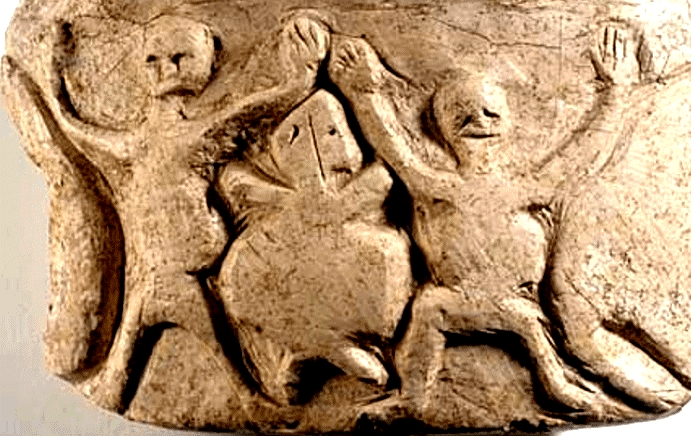
This image from Nevali Cori (Turkey) is said by Sidharth to represent the slow precession (turtle) and the Aswins (Horse Twins) appearing at the Winter Solstice around 7,300 BCE. Some have seen traces of the Vedic Civilisation in these areas such as Gobekli Tepe and Nevali Cori. This yuga started with a Solar Eclipse, something associated with other times too, periods linked to the end of a world-age and start of a new age. Interestingly, the author also then suggests that the origins of all this started in Atlantis around 10,000 BCE.
In regard to the ideas about the ‘War of the Gods’ and that this is reflected here on Earth by a Brother’s War, I’ll now turn to the Book of Revelations where this will be seen to be part of the apocalyptic change. In this we are told of the birth of the Divine Child which comes about through the planet Venus (Rev. 12:1). Then arose a ‘Great Red Dragon’ which tried to slay the Divine Child, and this caused a ‘war in heaven’ where ‘Michael and his angels fought against the dragon’ (Michael being a Dragon-Slayer). The Great Red Dragon, the Old Serpent called Satan, was cast out ‘to earth’, and his wrath was great, and there he persecuted the woman who bore the Divine Child. This, of course, will be playing out in our own time, with the coming of the Last Avatar, but here the interest lies in the Ur-Myth.
What we have here is the ‘War of the Gods’ which is the reflected onto Earth by a Great Brother’s War. But if we look closely at this it fits with the ideas of Miguel Serrano, who was adamant that the war lost here on Earth had to be so in order that the ‘War of the Gods’ be won in the heavens. This thus equates with the Ur-Myth, and since the work in Revelation is the latest that we have (the King James version was re-written in the time of James I) this seems to bear the essence of the UR-Myth in a different form. The battle in the heavens is won by the Gods against the Powers of Darkness! Since this version is based around the birth of the Avatar, and the suggestion here is that this is the ‘Son of Man’ – the Warrior-Krist, then this purports to our time, a time that follows the ‘War of the Gods’ in its Thule-Atlantean form.
The references to the birth of the Divine Child, and that of the ‘Mark of the Beast’ definitely mark this in our time. This is further enforced by the finding of the ‘White Stone’ which is also mentioned in Revelation (3:17). We are also told that the Red Dragon was wrath with the woman bearing the Divine Child, and went to make war with the remnant of her seed’ – which seems to parallel the drive for the destruction of the White Race. The ‘great flood’ sent by the Shaitanic Dragon may well be seen as the ‘pandemic’, since the term ‘flood’ has been used in symbolism rather than literal. It features in the Book of Sajaha in a similar way.
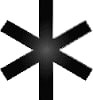
(This was meant to be a ‘short’ epilogue to the first work, but has (as usual) developed into a much longer piece. Believe this or not but these new ideas seem to have sprung from last week when I had to attend the local hospital to have my eyes checked and they used a scan in which the Hagal-Rune form was the point of concentration. The ‘star’ was of six staves and not joined up completely, but the symbol is the same. This seems to have triggered a subconscious reaction.)
Sincerely,
Richard Barrett
12-05-2025
Written by Wulf Ingessenu on 01-22-2025;
Published here on 12-05-2025, at 7:15 PM, somewhere in the USA…
Sources Cited
All other images courtesy of Wulf Ingessenu.
 PULP FICTION RENAISSANCE