If you’ve read “King Arthur’s Three-Fold Path of Masculinity” and “Morgan Le Fay’s Three-Fold Path of Emasculation”, then you know that Imagery is the foundation of everything.
If you want to turn yourself into the Confrontational Indo-European Warrior Hero, you must have the Ideal Image as such in your mind…the Knight slaying the Dragon to save the Princess!
And if you want to destroy these dreams, then Imagery is critical for the Inversion to do so too!
Whatever you do with your life and your body, whether good or bad, Imagery is the thing that makes it all possible!
But to truly understand Imagery and its role in achieving our dreams for good, we must look at it much, much deeper.
THE NERVOUS SYSTEM IS THE KEY
To truly understand Imagery and how it affects our lives, we must understand the Nervous System.
That’s because when it comes to Imagery to kickstart us into action, the Nervous System is the pathway through which said Imagery functions.
The Nervous System has two major components:
- The Central Nervous System: consisting of the Brain and Spinal Cord.
- The Peripheral Nervous System: this regulates the Somatic and the Autonomic Nervous Systems.
Both of these systems are composed of the base unit of the nervous system: the Neuron. Lots of little Neurons go up to make these systems.
In short, the Central Nervous System is the King ruling the Kingdom, and the Peripheral Nervous System is the Knight going out and doing the work.
And it has a lot of work to do!
AMPED UP AND CALMED DOWN
The Peripheral Nervous System’s actions in its various sub-divisions are vital to life…and the functions of the Indo-European Warrior Caste within it!
The Somatic Nervous System is what controls body movement.
The Autonomic Nervous System is what controls processes that are often involuntary. This consists of things like circulating blood through the body, digesting food for energy, and producing hormones in the internal organs.
The Autonomic Nervous System has two additional parts to it that are very important. These are parts that we can control voluntarily if we want to…but only through practice.
These consist of:
- The Sympathetic Nervous System: this amps us up and feeds us with stress to alert us to danger, getting us in the fight, flight or freeze response.
- The Parasympathetic Nervous System: this calms us down and lets us know we are ok.
Why does this matter, you ask?
Because both are critical to the activities of the Indo-European Warrior Caste!
SYMPATHY FOR THE DEVIL
As I have discussed before, the Postmodern Literary Critic Tom Englehardt lays out the Indo-European Warrior Mythology as being composed of two key parts.
These are composed of what he calls “The Ambush at Kamikazi Pass” and “The Spectacle of Slaughter”. I add a third part to this equation, as you shall see.
And all of three of them engage different parts of the Autonomic Nervous System in a big, big way!
“The Ambush at Kamikazi Pass” by the Predatory Foe amps up the Sympathetic Nervous System..the Fight, Flight, or Freeze Response.
Now you want the Sympathetic Nervous System amped up a little bit to let you know there is a threat, a danger from the foe. However, you don’t want the Sympathetic Nervous System too amped up.
If it’s too amped up, you freak out from fear, burn yourself out before you can even get out of the gate, and then you exhaust yourself…enacting the freeze response, which makes you easy pickings for the enemy!
That’s where the “Flow State” comes in.
THE MORAL FLOW
The “Flow State” is the modern day explanation for that legendary state of Indo-European Warrior Heroism…all within the context of the Nervous System terminology.
The US Pain Foundation explains the “Flow State” the best:
“The goal of flow state is to create a perfect balance between ‘relaxation’ and ‘focus,’
“Which means when your body is in flow state, it can generate just enough arousal from the sympathetic system to focus, while simultaneously engaging your parasympathetic system so that you feel relaxed and restored.”
“The Spectacle of Slaughter” is where the “Flow State” kicks in in the Indo-European Warrior Mythology.
The “Spectacle of Slaughter” where the Confrontal Heroes fight and win is the Flow State.
There’s enough Sympathetic activation to maintain focus that there is a dangerous foe, mixed with enough Parasympathetic activation to stay calm and confident to be able to take the dangerous foe out!
It’s the Parasympathetic System that allows you to believe you are the best, you are gonna win, and you deserve to win! All you gotta do is take action and you will win!
It’s the Parasympathetic System that is what Clausewitz calls the “Moral Forces of War.” These consist of “Courage, confidence, and cohesion.”
And as Napoleon famously said: “The Moral Forces are to the Physical what three is to one.”
These old Indo-European Warriors of the early 19th Century knew that the Sympathetic Nervous System was not enough on its own…
They knew it had to have the Parasympathetic Nervous System operating along with it to engage the “Flow State”…
To engage “The Spectacle of Slaughter”!
WHAT THE DUKE KNEW
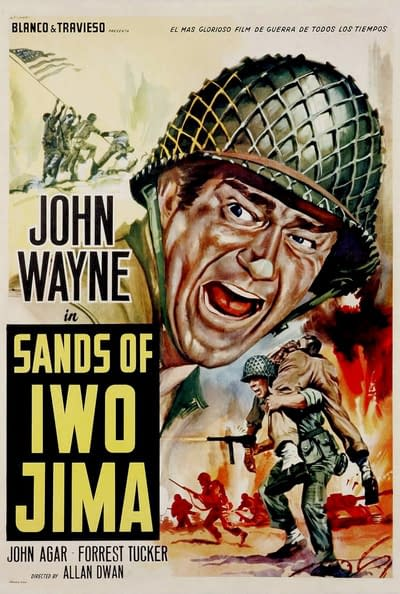
One of the best ways this has been illustrated in Indo-European Warrior Mythology is in Sands of Iwo Jima with John Wayne.
John Wayne, nicknamed Duke, embodied the Indo-European Warrior Hero in his Cowboy, Cavalryman, and G.I. varieties. And he didn’t just do it on screen either.
What few people know is that he did it off the screen as well.
During WWII, John Wayne desperately tried to get into the Military to fight…but the War Department wouldn’t let him.
So he went with the USO to Papua New Guinea in the Pacific Theater, to a unit commanded by an old childhood friend. Ostentatiously, his intent was to go and merely entertain the troops.
But with a gleaming twinkle in his eye, and a smile upon his lips, John Wayne had bigger plans.
When he got there, he ditched protocol…and spent three months fighting in combat with the troops as a civilian!
One soldier, Fred Sofft, recalled “I looked around and here alongside of me, here’s Duke. And I said, ‘What the devil are you doing here?’ And he said, ‘I want to go and see what’s going on.’
“Well, if he’d been hurt, we’d have been in trouble, because he had no business being up in that area anyway…There was actual fighting and he was part of that.”[1]
Seeing their childhood TV cowboy hero playing “Cowboys and Indians” in real life with real bullets against the real Japanese foe had an electrifying effect on the American troops!
Another soldier, Keith Honaker, remembered the effect well:
“He became one of us. He was just like everyone else. He showed us that he really was a down-to-earth guy…He didn’t ask for any protection…He actually did off the screen what he did on the screen.”[2]
Many, including Honaker, went to work for John Wayne’s film company after the War because of their great respect for the man who fought at the front even though he didn’t have to!
And all these experiences went into the Indo-European Mythological tale the Duke told in Sands of Iwo Jima.[3]
AMERICAN KRISHNA
Sands of Iwo Jima, whether consciously or not, is the re-telling of the Bhagavad Gita in WWII.
Instead of Aryans and Dravidians, it’s Americans and Japanese…and John Wayne is Krishna himself!
John Wayne plays Sgt. Stryker, a Marine Sergeant who has to get his fresh-faced Marines battle-ready for the rigors of the Pacific Theater.
After training them for months, John Wayne and his Marines land under withering fire on the bloody beaches of Tarawa.
Taking cover behind the atolls as bullets and high explosives fly above their heads, Duke’s Marines start freaking out. Panic sets in during their first battle, and they don’t know what to do.
They’re mired in the Sympathetic Nervous System. It has taken them over completely.
They look over to John Wayne to see what he will do…the leader, the man with the plan.
American Krishna.
You can see stress on John Wayne’s granite visage. His Sympathetic Nervous System is firing full bore too.
Then calmly as if it were nothing, John Wayne pulls out a cigarette from his pocket and lights it. He starts breathing deeply, and calms down instantly.
He’s kicking in his Parasympathetic Nervous System.
A few moments more, and he’s in the “Flow State”…both sides of the Nervous System coin are in play, and he begins leading his Marines onward to victory!
“The Spectacle of Slaughter” proceeds as the American Heroes win the day!
OF COURSE!
There is a third part of the Indo-European Warrior Mythology that Tom Englehardt does not address.
After the enemy is defeated and the “Spectacle of Slaughter” avenges the “Ambush at Kamizaki Pass”, the Indo-European Warrior Heroes have won the day, and have achieved Peace and Victory.
The Dragon is slayed.
The Princess is rescued.
And now is the time for the Parasympathetic Nervous System to kick in in full.
No more need for the Sympathetic Nervous System for now.
Now is the time of rest, relaxation, and fun!
And how does the Knight celebrate with his Princess?
With Tantric Sex, of course!
Sincerely,
Richard Barrett
08-08-2023
Written at 5:31 PM, somewhere in the USA…
[1] Eyeman, Scott. John Wayne: The Life and Legend. New York: Simon & Schuster, 2014. Pg. 134.
[2] Ibid.
[3] For the entire story, see Eyeman, Scott. John Wayne: The Life and Legend. New York: Simon & Schuster, 2014. Chapter Seven, Pgs. 128-145, Chapter 8 146-147
 PULP FICTION RENAISSANCE