I suspected my last piece on MKUltra would cause quite a stir…and cause quite a stir it did!
Some people thought the article was too explosive…
While others thought the article was not explosive enough!
But one reader, a hard-hitting alternate history novelist known simply as Bandy, has asked the Million Dollar Question:
“Tell me, does Anna Paulina Luna make a connection between the Third Reich and MKUltra?
“And did we recruit Nazi psychiatrists or propagandists for MK Ultra like we recruited physicists + engineers for Operation Paperclip?”
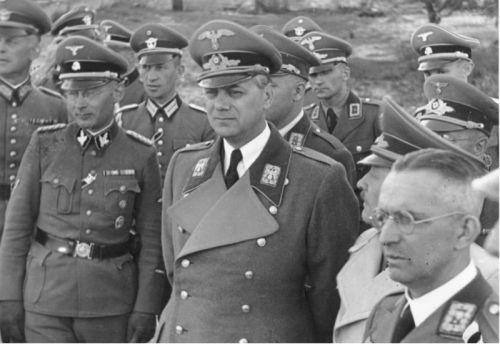
MEET ALFRED ROSENBERG
To answer Bandy’s question, we’ve gotta take a look back in time to figure forgotten by most of history, a fella most of you have probably never heard of before…
A fella named Alfred Rosenberg.
Alfred Rosenberg was a Mythologist, Philosopher, and Historian…in league with the likes of Carl Jung, Joseph Campbell, and Will Durant! [1]
He operated from the late 1910s to the 1940s, and because he was on the wrong side of the War, he gets a bad rap today…
And that’s when he even gets mentioned at all.
But the historical record and his firsthand writings alike shows him to be one of the most insightful, intelligent, and humanitarian members of the Third Reich.
In fact, Rosenberg consistently used his power and influence within the Regime to ensure fair and humane treatment for conquered populations…
Putting him at odds with more harsh and heavy-handed members of the Third Reich like Heinrich Himmler and Martin Borman.
And he did all this while being one of the most influential intellectual figures in the forgotten history of the 20th Century. [2]
ALFRED ROSENBERG’S BIG 3
Alfred Rosenberg’s flagship book is The Myth of the 20th Century, published in 1930.
He bases his work on 3 major ideas.
I call them “The Alfred Rosenberg’s Big 3”.
They are:
- Soul (Atman)
- Universe (Brahman)
- Blood (Blut)
Just what are these 3 things, you ask?
And how do they connect to MKUltra?
To find out, let’s take a look at each one in turn.
THE MYSTERY THE BLOOD
The Soul is pretty easy…it’s the Self, it’s you…the Real You!
The Universe isn’t too hard either…it’s like the sea, the ocean, and open space way out beyond Earth.
But it’s the Blood where people get confused about Rosenberg.
When people hear him use the term Blood, it’s sometimes translated into English as Race.
Consequently, this leads people to conjure up images of biological, genetic determinism. Cold, sterile, and arrogant alike.
People hear this, and they think robotic, dead-end Materialism, plain and simple…
Nothing Spiritual comes to mind at all! [3]
And not to mention the “moral evil” that people so often times associate with the term!
But a closer reading of Alfred Rosenberg reveals that he means something much more than the mere Material…
And something far from the bitter hatefulness that most have been led to believe.
WHAT ART REVEALED ABOUT THE SECRETS OF FORM
When Alfred Rosenberg uses the German term Blut, what he is talking about is Form.
What is Form, you ask?
Form comes from two Greek words, Eidos and Morphe. These words are used synonymously.
These words taken together mean Idea, Image, and Shape. They are also where we get the words Ideals, Imagination, and Figure from. [4]
But the key word here is Shape.
Shape provides a definite and very specific border. To put it in modern psychology terms, the Shape constitutes a Psychological boundary.
But a boundary makes you think of an invisible straight line running across the land.
Rosenberg meant something much, much more than that.
You see, Alfred Rosenberg was an artist first and foremost, with his specialty being figure drawing.
And because of this, he thought of Shape in terms of Classical Greek art statues…the same way Ancient Greeks like Plato and Aristotle thought of Form.[5]
Without a Shape, the bronze of the statue can’t be shaped into a statue at all.
Because at the end of the day, the Material doesn’t matter. It is the Shape, existing independently of the material of marble or bronze, that makes the statute into a statue…
Otherwise, it’s just a blob of bronze!
It’s the Shape that is the main thing. [6]
Now if you choose the Shape of Apollo, the statue becomes Apollo.
And if you choose the Shape of Achilles, the statue becomes Achilles.
The statue becomes the Shape you choose.
That’s because the Shape makes the Identity.
The Shape makes the Soul.
This is what Alfred Rosenberg means when he talks about Form.
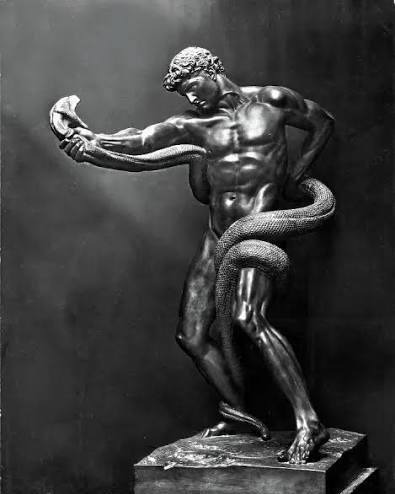
Apollo in Agon, slaying the Serpent Son of Mother Gaia at Delphi, depicted in An Athlete Wrestling With a Python by Frederic Leighton, 1877.
APOLLO IDENTIFIED!
Alfred Rosenberg explains that his ideal Form is that of Apollo…proto-typical Indo-European Warrior Guardian par excellence.
The Form of Apollo is what can only be described as a kind of Heroic Masculine Beauty…consisting of Nobility and Fairness in Agon and Harmony alike. [7]
Through his extensive study of Mythology, Philosophy, and History, Rosenberg identified Apollo as the ideal Form unique to the Soul of the Indo-European people…
Because in his understanding, each people had a special Form that constituted their own unique Soul.
So with this understanding under our belts, “The Alfred Rosenberg Big 3” is more accurately described as:
- Soul (Atman)
- Universe (Brahman)
- Form (Eidos and Morphe)
Now sometimes, different Forms are friends.
And sometimes, different Forms are foes!
But the worst thing to all is to lose the Form itself, because if you do, big trouble is on the way…
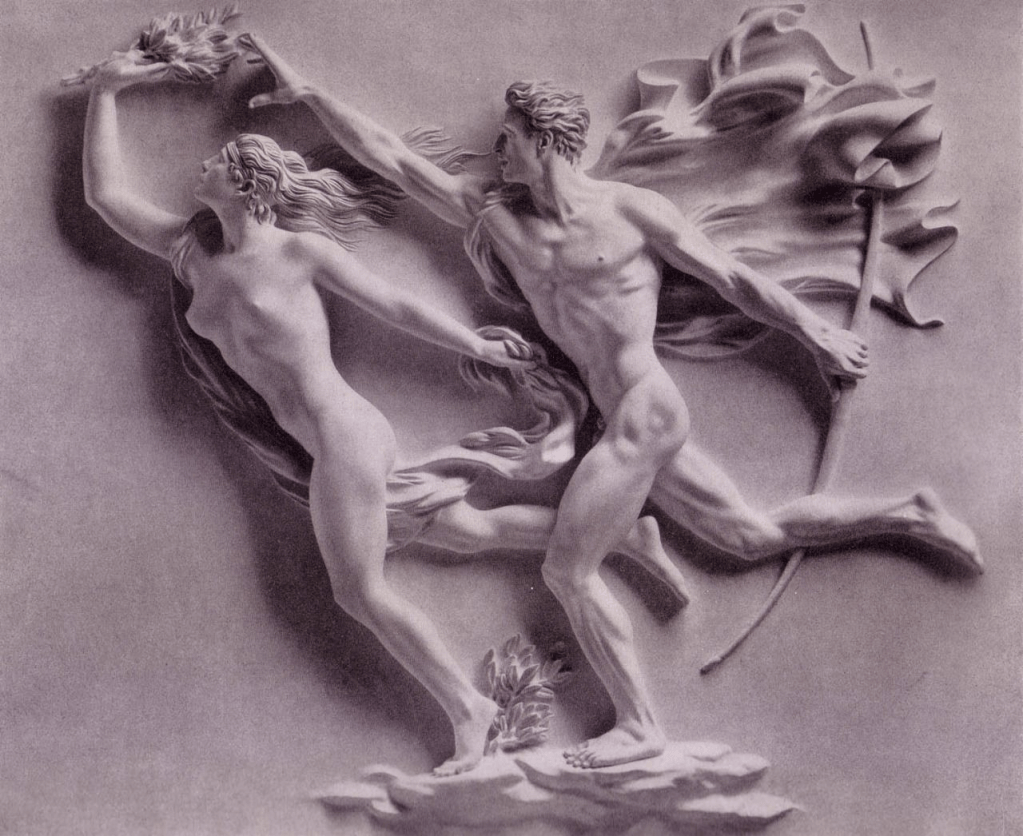
Apollo in Harmony, depicted in Apollo and Daphne by Arno Breker, 1940.
ARE YOU SAILING OR DROWNING?
Alfred Rosenberg explains that the Soul and the Form are one in the same.
When the Soul has its Form, it can sail upon the Universe, like the Ancient Apollo-venerating Indo-Europeans of old sailed upon the ocean on their swan ships.
But when the Soul loses its Form, then it becomes dissolved into the Universe, liquidating into Nothingness…
And is gone forever.[8]
And it is this loss of Form that is the goal of MKUltra.
REVERSE ENGINEERING THE BEST IN THE BUSINESS
As I laid out in my previous article, “MKUltra & The Secrets of The Third Reich: A Pulp Fiction Renaissance Investigation”, the goal of MKUltra has is that of psyche destruction.
And what does the Greek word Psyche mean?
It is the Greek word for Soul! [9]
Psychology is literally the Logic of the Soul.
And as Alfred Rosenberg laid out, the way to destroy the Soul is to destroy the Form!
And as he explained conversely, the way to build the Soul is to shape it into its Ideal Form!
Alfred Rosenberg’s goal was to build the Soul of the Indo-European people into its Ideal, Apollonian Form.
That’s what he meant with the title of his flagship book, The Myth of the 20th Century.
And the goal of MKUltra has been to do just the opposite.
So why not just reverse engineer the process of one of the best guys in the business?
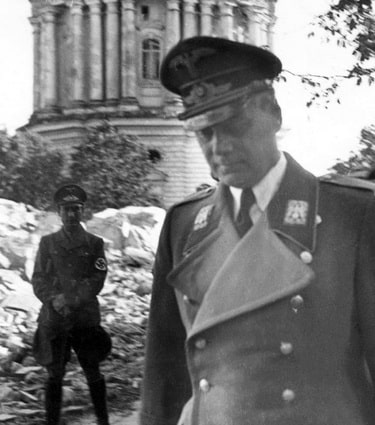
THE EVIDENCE IS BEFORE YOU!
But don’t just take my word for it.
Check out Alfred Rosenberg and his writings for yourself…and as well as the writings of all the scholars, intellectuals, and artists throughout the centuries who inspired him!
They’re all found in the footnotes below.
And when you compare them to all the documents revealed in the recent congressional investigations into MKUltra reported on above…
You might just be shocked at what you find!
Sincerely,
Richard Barrett
08-14-2026
Written at 11:01 PM, somewhere in the USA…
Sources Cited
Image 2 .
[1] For Alfred Rosenberg’s writings, see his flagship book, Rosenberg, Alfred. The Myth of the 20th Century. Translated by Bird, Vivian. Edited by Dalton, Dr. Thomas. Originally published by Hoheneichen-Verlag, München, 1930. Re-published by NS-Requim Publications, 2022.
For a deeper understanding of this book and the background that went into writing it, see Rosenberg, Alfred. Memoirs. Crestview, FL: Ostara Publications, 2015.
For his foundational article on “Form and Forming” that he describes in his Memoirs, see Rosenberg, Alfred. Schriften und Reden, Band 1: Schriften aus den Jahren 1917–1921. Hoheneichen-Verlag, München, 1943. This article is currently being translated into English at request of the the current author of this article, Richard Barrett.
For more of Rosenberg’s thoughts on Science, see Gómez-Jeria, Juan Sebastián. “Alfred Rosenberg on Gutenberg, Copernicus, Kant, Freedom of Research and Worldview and Science.” Journal of Advances in Education and Philosophy 8, no. 01 (January 23, 2024): 13–31. https://doi.org/10.36348/jaep.2024.v08i01.002.
For an analysis of his intellectual system by those closest to him, see Gómez-Jeria, Juan Sebastián. “Alfred Baeumler: ‘Alfred Rosenberg and the Myth of the 20th Century.’” Journal of Advances in Education and Philosophy 8, no. 03 (March 30, 2024): 197–233. https://doi.org/10.36348/jaep.2024.v08i03.007.
For an understanding of Neoclassicism that influenced Alfred Rosenberg, particularly the work of Johann Joachim Winckelmann, see both Eitner, Lorenz. Neoclassicism and Romanticism, 1750-1850: Volume I: Enlightenment/Revolution. Ed. H.W. Janson. Englewood Cliffs, NJ: Prentice-Hall, Inc., 1970 and Eitner, Lorenz. Neoclassicism and Romanticism, 1750-1850: Volume II: Restoration/Twilight of Humanism. Ed. H.W. Janson. Englewood Cliffs, NJ: Prentice-Hall, Inc., 1970.
For a neutral, basic overview of Alfred Rosenberg, see Lafond, James. Blue Eyed Daughter of Zeus: A Counterculture Exposition of An Unforgiven Book. Monee, IL: A Crackpot Book, 2021.
For an in-depth account of his political activities on the Eastern Front during WWII, see Thorwald, J. J. The Illusion: Soviet Soldiers in Hitler’s Army. Boston, MA: Houghton Mifflin Harcourt Publishing Company, 1978.
For Alfred Rosenberg’s inner, private thoughts during this entire time period, see Matthäus, Jürgen, and Frank Bajohr, eds. The Political Diary of Alfred Rosenberg and the Onset of the Holocaust. Lanham, MD: Rowman & Littlefield, in association with the United States Holocaust Memorial Museum, 2015.
[2] For an in-depth account of his political activities with conquered populations during WWII, see Thorwald, J. J. The Illusion: Soviet Soldiers in Hitler’s Army. Boston, MA: Houghton Mifflin Harcourt Publishing Company, 1978.
For Alfred Rosenberg’s own account of these activities in his own words, see Rosenberg, Alfred. Memoirs. Crestview, FL: Ostara Publications, 2015.
For Alfred Rosenberg’s inner, private thoughts during this entire time period, see Matthäus, Jürgen, and Frank Bajohr, eds. The Political Diary of Alfred Rosenberg and the Onset of the Holocaust. Lanham, MD: Rowman & Littlefield, in association with the United States Holocaust Memorial Museum, 2015.
[3] Even the even-handed, neutral, and fair observer James Lafond makes this mistake in Lafond, James. Blue Eyed Daughter of Zeus: A Counterculture Exposition of An Unforgiven Book. Monee, IL: A Crackpot Book, 2021.
The usually far-sighted Julius Evola makes the same mistake as well in Evola, Julius. Translated by Leonard, John Bruce. The Myth of the Blood: The Genesis of Racialism. London, England: Arktos Media Ltd., 2018.
[4] Eidos is defined as: “that which is seen: form, shape, freq. in Hom., of the human form or figure…form, kind, or nature” in Liddell, Henry George, and Robert Scott. s.v. “εἶδος.” A Greek-English Lexicon. Revised and augmented throughout by Sir Henry Stuart Jones with the assistance of Roderick McKenzie. 9th ed. Oxford: Clarendon Press, 1940. Digital edition available at LSJ.gr. Accessed August 15, 2026. https://lsj.gr/wiki/%CE%B5%E1%BC%B6%CE%B4%CE%BF%CF%82.
Eidos is alternatively defined as “appearance, fashion, shape, sight” in “εἶδος.” Strong’s Greek 1491. In Bible Hub. Accessed August 15, 2026. https://biblehub.com/greek/1491.htm.
Morphe is defined as “form, shape…fashion, appearance” in Liddell, Henry George, and Robert Scott. s.v. “μορφή.” A Greek-English Lexicon. Revised and augmented throughout by Sir Henry Stuart Jones with the assistance of Roderick McKenzie. 9th ed. Oxford: Clarendon Press, 1940. Digital edition available at the Perseus Digital Library. Accessed August 15, 2026. https://www.perseus.tufts.edu/hopper/text?doc=Perseus:text:1999.04.0057:entry=morfh/.
Aristotle himself says that Eidos and Morphe are the same: “The form [morphē] and the essence [eidos] are the same” he writes in Aristotle. Metaphysics Z (VII) 7, 1032b1–2. Translated by W. D. Ross. In The Complete Works of Aristotle: Volume One, edited by Jonathan Barnes. Princeton: Princeton University Press, 1984.
[5] For an explanation of Alfred Rosenberg’s artistic experiences in figure drawing and art history study influencing his understanding of Form, see Rosenberg, Alfred. Memoirs. Crestview, FL: Ostara Publications, 2015.
For an understanding of Neoclassicism that influenced Alfred Rosenberg, particularly the work of Johann Joachim Winckelmann, whom Rosenberg cites in The Myth of the 20th Century, see both Eitner, Lorenz. Neoclassicism and Romanticism, 1750-1850: Volume I: Enlightenment/Revolution. Ed. H.W. Janson. Englewood Cliffs, NJ: Prentice-Hall, Inc., 1970 and Eitner, Lorenz. Neoclassicism and Romanticism, 1750-1850: Volume II: Restoration/Twilight of Humanism. Ed. H.W. Janson. Englewood Cliffs, NJ: Prentice-Hall, Inc., 1970.
For the Classical Greek view of Form, see the material covered in Footnote [4] above, as well as both Footnotes [8] and Footnotes [9] listed below. Also see Barrett, Richard. “Quest for the World of Form: How Physics and Biology Have Failed Us, and How We Can Fix It!” Pulpfictionrenaissance.com. June 15, 2025. https://pulpfictionrenaissance.com/2025/06/14/quest-for-the-world-of-form-how-physics-and-biology-have-failed-us-and-how-we-can-fix-it/.
[6] For more on this idea, see Barrett, Richard. “Quest for the World of Form: How Physics and Biology Have Failed Us, and How We Can Fix It!” Pulpfictionrenaissance.com. June 15, 2025. https://pulpfictionrenaissance.com/2025/06/14/quest-for-the-world-of-form-how-physics-and-biology-have-failed-us-and-how-we-can-fix-it/.
[7] For the ideas behind Nobility, see Barrett, Richard. “The Final Missing Puzzle Piece: How Beasts of Aryas Helped Create Pulp Fiction Renaissance!” Pulpfictionrenaissance.com. February 12, 2026. https://pulpfictionrenaissance.com/2026/02/12/the-final-missing-puzzle-piece-how-beasts-of-aryas-helped-create-pulp-fiction-renaissance/.
For the ideas behind Fairness, see Barrett, Richard. “We All Get the Same Shot: Psychologist Reveals the Secret Key to the Indo-European Warrior Caste!” Pulpfictionrenaissance.com. July 23, 2025. https://pulpfictionrenaissance.com/2025/07/23/we-all-get-the-same-shot-psychologist-reveals-the-secret-key-to-the-indo-european-warrior-caste/.
For the ideas behind Agon see both Barrett, Richard. “The Eagle & The Snake I: The Secret Key to Pulp Fiction ”. Pulpfictionrenaissance.com. July 26, 2022. https://pulpfictionrenaissance.com/2022/07/26/the-eagle-the-snake-the-secret-key-to-pulp-fiction/ as well as Barrett, Richard. “The Eagle & The Snake: The Solar, Lunar, and Telluric Secrets of Pulp Fiction”. Pulpfictionrenaissnace.com. February 13, 2026. https://pulpfictionrenaissance.com/2026/02/13/the-eagle-the-snake-ii-the-solar-lunar-and-telluric-secrets-of-pulp-fiction/.
For the ideas behind Harmony, in opposition to Postmodern Thought, see Barrett, Richard. “The Blasphemy of Inversion: Morgan Le-Fay’s Three-Fold Path of Emasculation”. Pulpfictionrenaissance.com. July 27, 2023. https://pulpfictionrenaissance.com/2023/07/27/the-blasphemy-of-inversion-morgan-le-fays-three-fold-path-of-emasculation/.
[8] Note that Aristotle says that “The soul is the first actuality (or first entelechy / ἐντελέχεια) of a natural body that has life potentially within it.” Found in Aristotle, De Anima II.1 (412a19–21). Translated by R. D. Hicks. Cambridge: Cambridge University Press, 1907.
Also note that Aristotle says that “Hence the soul must be a substance in the sense of the form (eidos) of a natural body having life potentially within it.” Found in Aristotle, De Anima II.1 (412b4–6). Translated by J. A. Smith. In The Complete Works of Aristotle: Volume One, edited by Jonathan Barnes. Princeton: Princeton University Press, 1984.
[9] See the Footnote [8] above. Psyche is translated from the Greek, becoming Anima in Latin, and Soul in English.
For the definition of Psyche, see Liddell, Henry George, and Robert Scott. s.v. “ψυχή.” A Greek-English Lexicon. Revised and augmented throughout by Sir Henry Stuart Jones with the assistance of Roderick McKenzie. 9th ed. Oxford: Clarendon Press, 1940. Digital edition available at LSJ.gr. Accessed August 15, 2026. https://lsj.gr/wiki/%CF%88%CF%85%CF%87%CE%AE.
For the definition Anima, see Lewis, Charlton T., and Charles Short. s.v. “anima.” A Latin Dictionary. Oxford: Clarendon Press, 1879. Digital edition available at Alatius. Accessed August 15, 2026. https://www.alatius.com/ls/index.php?l=anima.


1 thought on “MKUltra & The Secrets of the Third Reich II: The Alfred Rosenberg Connection!”